Mistakes on Maps - Fringe 2026
Step 0 of 0
1
2
3
4
5
6
7
8
9
10
11
12
13
14
15
16
17
18
19
20
21
22
23
24
25
26
27
28
29
30
31
32
33
34
35
36
37
38
39
40
41
42
43
44
45
46
47
48
49
50
51
52
53
54
55
56
57
58
59
60
61
62
63
64
65
66
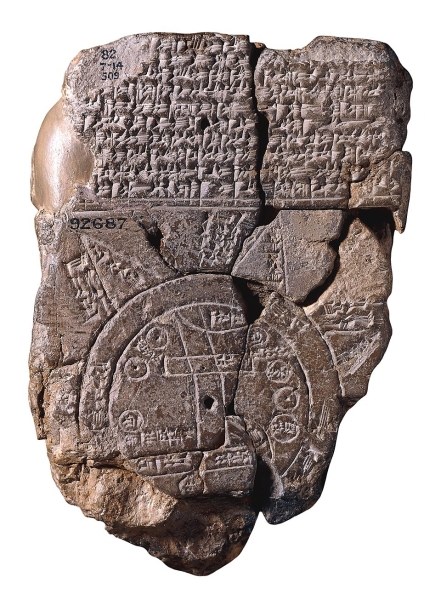
Babylonian Map of the World - 8th Century, BC
https://en.wikipedia.org/wiki/Babylonian_Map_of_the_World
i41204
i41205
i412061. "Mountain" (Akkadian: šá-du-ú)
2. "City" (Akkadian: uru)
3. Urartu(Akkadian: ú-ra-áš-tu)
4. Assyria(Akkadian: kuraš+šurki)
5. Der (Akkadian: dēr) (a city)
6. ?
7. Swamp (Akkadian: ap-pa-ru)
8. Susa (capital of Elam) (Akkadian: šuša)
9. Canal/"outflow" (Akkadian: bit-qu)
10. Bit Yakin(Akkadian: bῑt-ia-᾿-ki-nu) (a region)
11. "City" (Akkadian: uru)
12. Habban (Akkadian: ha-ab-ban) (a Kassite land and city)
13. Babylon(Akkadian: tin.tirki), divided by Euphrates
14 – 17. Ocean (salt water, Akkadian: idmar-ra-tum)
19 – 22 (and 18?). outer "regions" (nagu):
18. "Great Wall, 6 leagues in between, where the Sun is not seen" (Akkadian: BÀD.GU.LA 6 bēru ina bi-rit a-šar Šamaš la innammaru). – The "Great Wall" may be a mountain ridge, the "6 leagues in between" probably refer to the width of the Ocean.[16]
19. "nagu, 6 leagues in between"
20. "[nag]u[..." (rest of text missing)
21. "[na]gu[..." (rest of text missing)
22. "nagu, 8 leagues in between"
23. No description. (a city in Assyria?)
24, 25. No description. (cities in Habban?)
[ 2025-11-29 15:09:12 ]
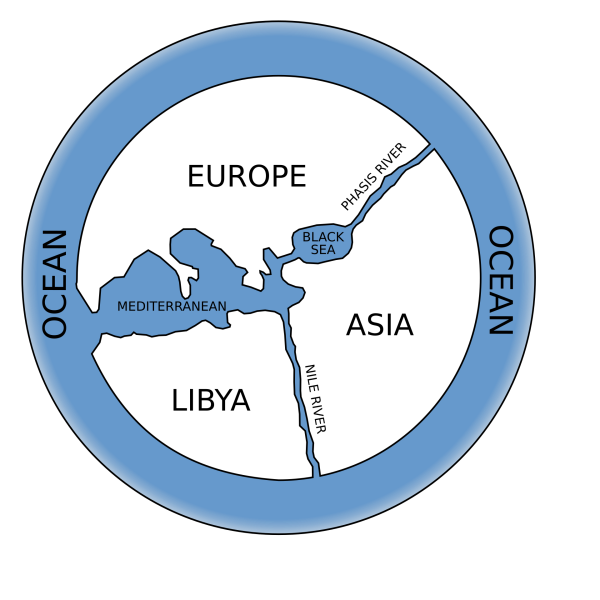
Animaxander's View of the World - 6th Century, BC
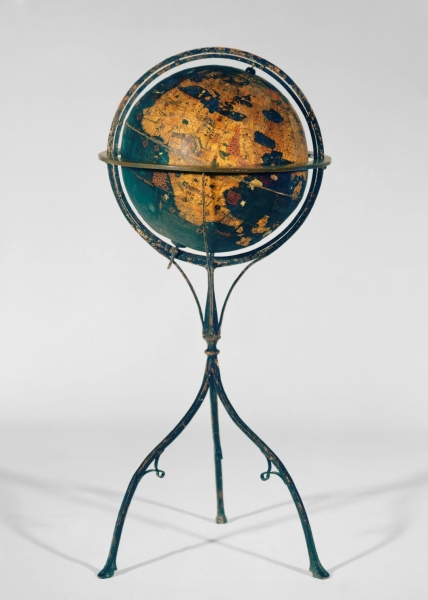
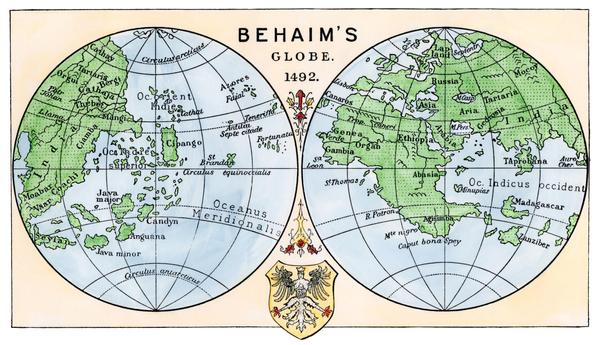
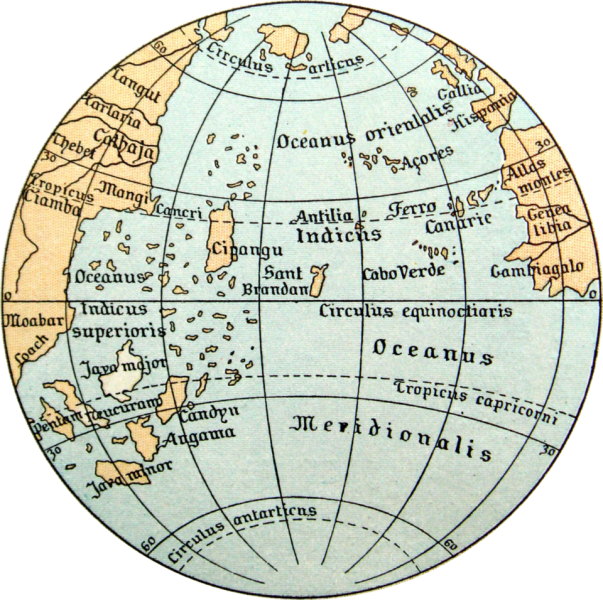
Ocean Map - from globe by Martin Behaim - 1492
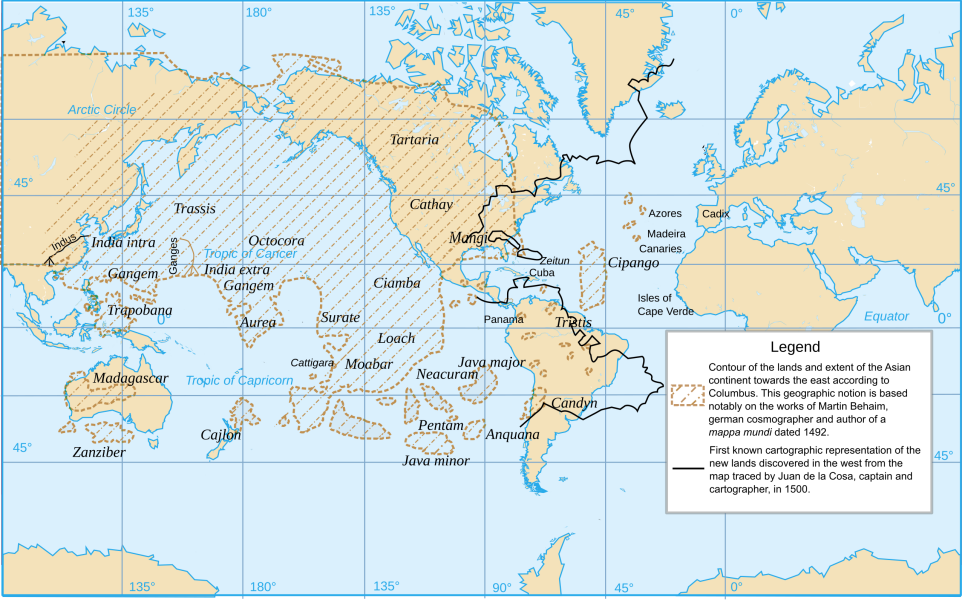
What Columbus Thought
https://commons.wikimedia.org/wiki/File:Conceptions_Colomb_map-fr.svg
[ 2025-11-30 20:03:12 ]
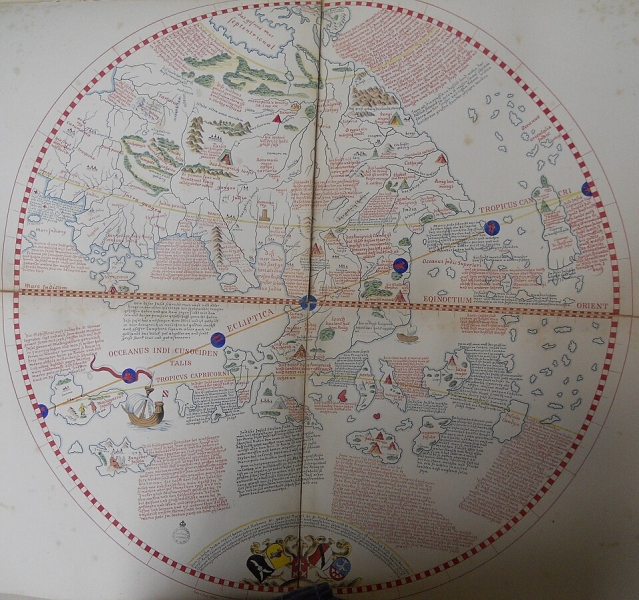
Martin Behaim 1492 - Eastern Hemisphere
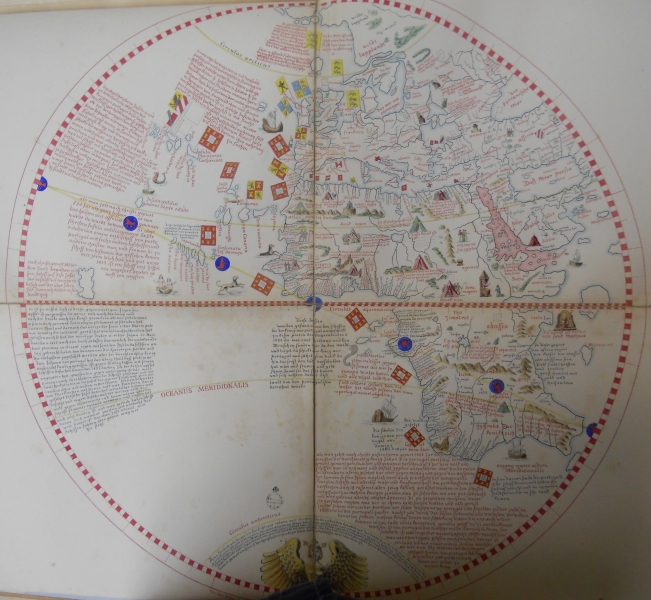
Martin Behaim 1492 - Western Hemisphere
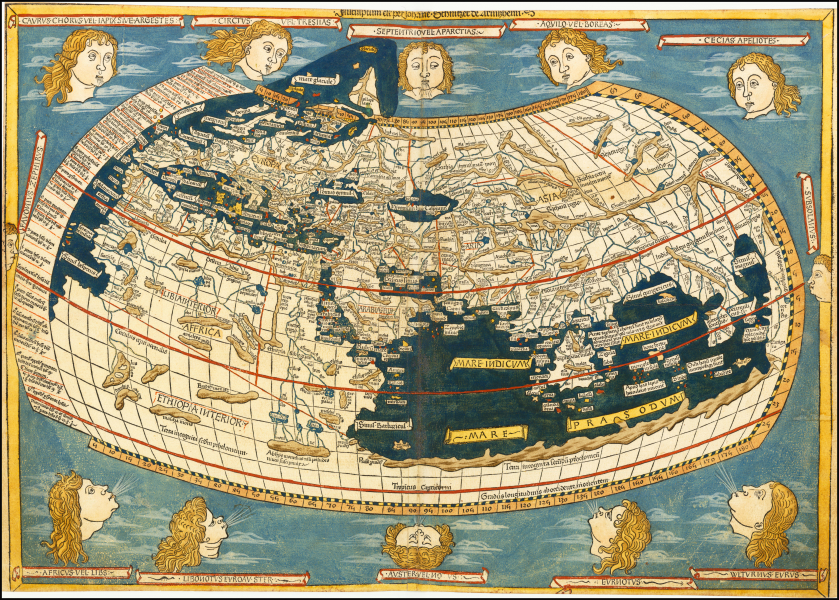
Ulm Ptolemy - 1482
When you are a map nerd, you get questions like "What's your favorite map?" and "What was the first map ever made?"
For me, the answer to each question is the same, this map made in Ulm, Germany, in 1482AD. It is a map from a book written by Ptolemy in about 170AD. When the Roman empire fell, a copy somehow made its way to Bagdad, where it was translated in about 800AD into Arabic during the Islamic Golden Age. In about 1400AD, a copy of that book in Arabic made its way back to Europe, where it became the basis of this map.
It reminds me of how we are all connected, across both generations and cultures.
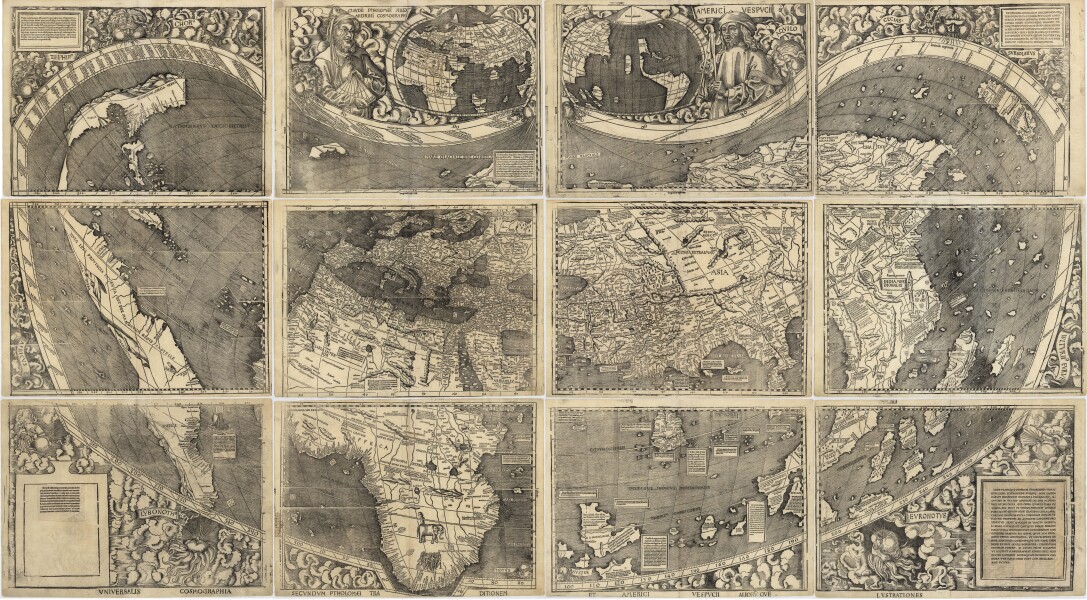
The World - Waldseemueller - 1507
Or what's the story behind the word "America" on this 1507 map? And you find that this map was the first to use the word America because even in 1507 Columbus continued to insist he had found the East Indies while Amerigo Vespucci, the second explorer to get to America, believed it was a new land.
The history of San Francisco begins with the history of the Americas coming into focus. This 1507 map by Waldseemueller shows great detail about Europe, but a lot less about North and South America. It also is the first map that ever showed the word “America.”


i36724i36724
i36725i36725
“In 2003, the Library of Congress bought Martin Waldseemüller’s world map for a world record $10 million dollars, because it is the first map to name America and show the Pacific. Widely regarded as ‘America’s birth certificate’, the map was believed lost until found by a Jesuit priest in a castle in Germany in 1900, where it remained 2003, when the library persuaded its owner, a German count, to sell it. Made by Waldseemüller and a team of scholars in Germany in 1507, its distinctive bulb-shaped projection reflects their attempt to keep up with the extraordinary period of rapid discoveries made by the Spanish and Portuguese from the late fifteenth century, including landfalls in southern Africa, India, Asia, and of course, the Americas. At the top of the map are Ptolemy (left) and Amerigo Vespucci (right), whose voyages proved conclusively that America was a separate continent, disproving Columbus’ belief that he had landed in Asia. It is a map that remains full of mysteries: how did Waldseemüller know about the Pacific six years before any European discovered it?” Time.com 2013
https://www.loc.gov/item/2003626426/
https://blogs.loc.gov/maps/2015/11/mr-duerer-comes-to-washington/
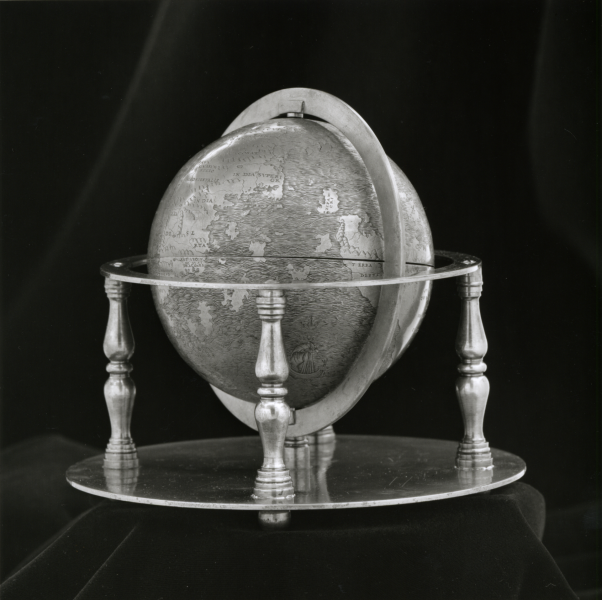
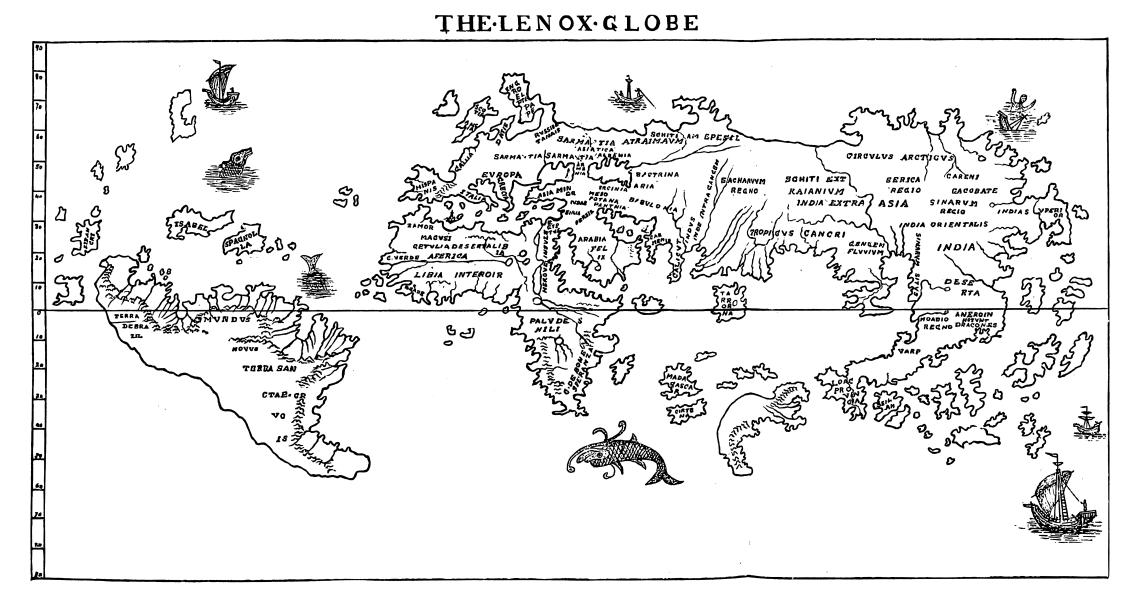
Lenox Globe - 1508
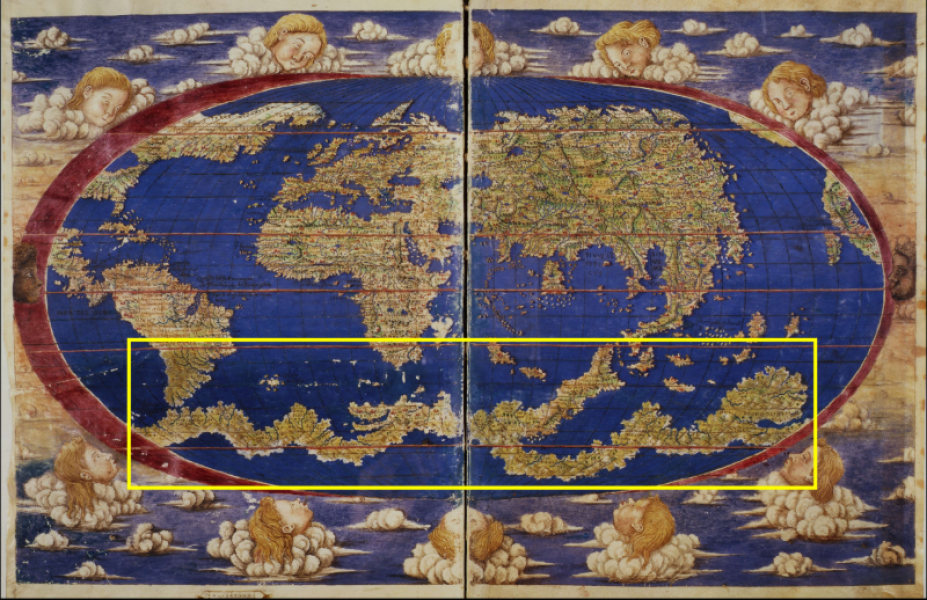
The Great Southern Continent Below
Oval planisphere - 1530 - Biblioteca Vaticana, codex Urb Lat 274
Chet's presentation to HIST23C
1530, Oval planisphere_Biblioteca Vaticana, codex Urb Lat 274
Nice map but little known. Unknown author. The map was created in a historical period where exploration was continually revealing new discoveries. At creation it was already outdated and was inserted into a Ptolemaic code of the previous century and forgotten.
The map is in oval projection similar to the one printed by Francesco Rosselli in 1508. Asia is depicted as per Ptolemy but derived from a map of Henricus Martellus. Close the the Moluccas island is signed a «arcipelago do magaliahanes». Japan (not yet reached) is depicted close to America. More interesting the New World; It is presents the Strait of Magellan discovered by the 1522/1523 expedition of the same name and the so-called Verrazzano Sea in North America; a supposed canal that connected North America with the Pacific Ocean and discovered based on erroneous observations by the navigator Giovanni da Verrazzano in 1524. The meandering and very decorative shape of the mythological continent Australes/Antarcticus is curious.
In 1529 the Papacy received from the King of Spain and Emperor Charles V a copy of the Spanish Padron Real executed by Diogo Ribeiro; the so called “Planisphere Propaganda Fide”; the most updated map of the world of the time, based exclusively on real explorations and in which the coast of North America appeared intact without interruptions as from the Spanish explorations of the years 1525-1528. It is probable that the arrival of Padron Real in the Vatican made this mappamundi obsolete to the point of relegating it to an old book but only as additional decoration.
[ 2025-11-23 22:06:08 ]
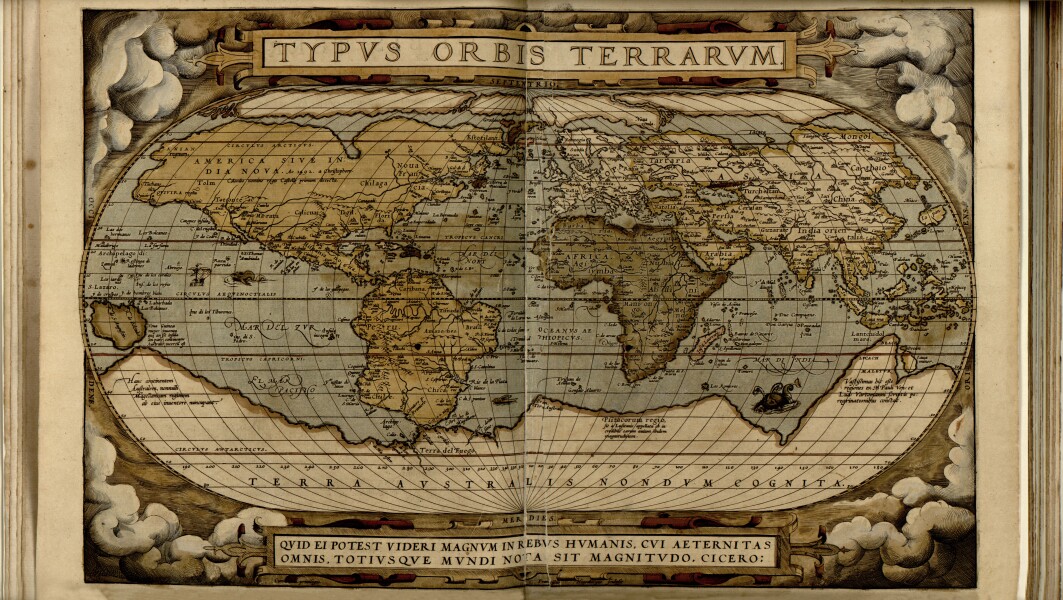
Typus Orbus Terrarum - Ortelius - 1570
Then you realize that not everything on a map is true, like the "Great Southern Continent Below," shown on this 1570 map. The ancient Greeks had been the first to believe there must be a large Southern Continent to counterbalance the Northern Hemisphere's landmass.
source: perplexity
Abraham Ortelius’s 1570 “Typus Orbis Terrarum” is the first modern world map published in an atlas. Centered on the Atlantic, it shows a blend of recent exploration and myth, most notably the unknown southern continent, an idea dating back to ancient Greece.
“Ortelius' book of maps, first published in 1570, is considered the first modern world atlas. It was the first time that a set of maps, contemporary to the date of publication, was designed, drawn, and engraved with the intention of publishing them in a bound volume. Ortelius did not refer to his publication as an "atlas," as we know it today. Rather he entitled it "Theater of the World," implying not only that the entire known world could be viewed in this one book, but that the Earth was a stage on which human actions unfolded. Although most of the maps in this book pertain to European countries and provinces, it can be considered a world atlas because it also includes a map of the world (displayed here), as well as one map for each of the four continents. The featured map is from the second state and was published c.1578 and is similar to the first state map, but with a few corrections. It is one of the most recognized maps from the Age of Discovery. This version includes the mythical Great Northern Passage, an irregular "bulge" on the west side of South America and the mythical Great Southern Continent, "Terra Australis Ingognita," roughly in the place of Antartica before its discovery. Most of North America is still based on conjecture and mythology, though he does credit Columbus for its discovery.” Steve Hanon, themapmaven.com
https://www.loc.gov/resource/g3200m.gct00003/?sp=18 http://www.themapmaven.com/my-map-gallery
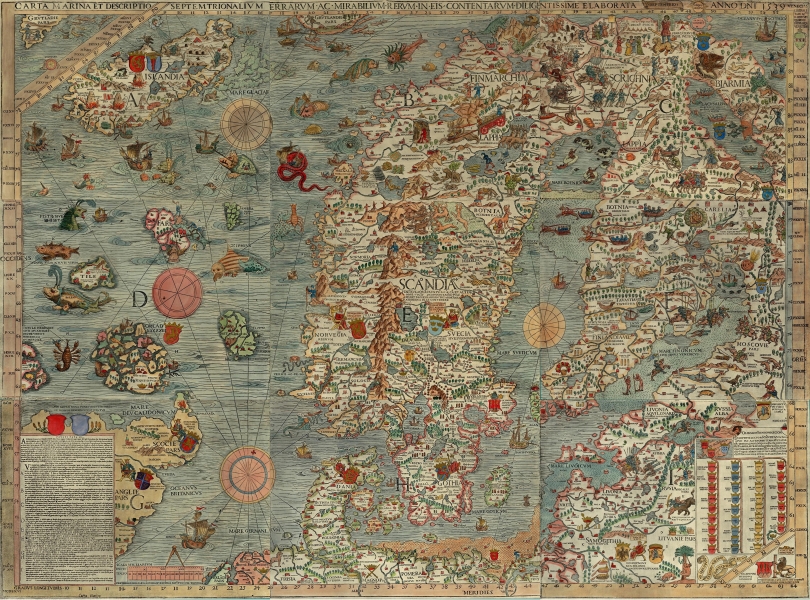
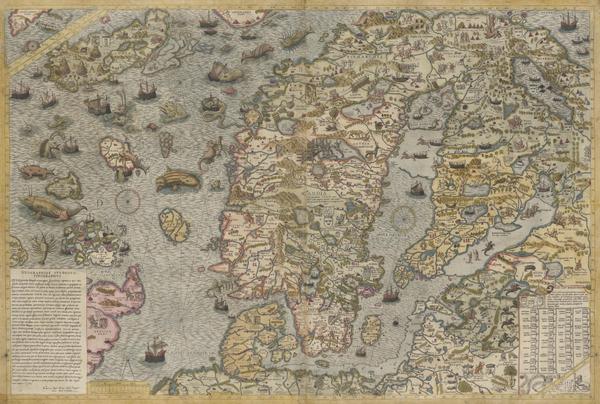
Carta Marina - Olaus Magnus - 1539
Scope and purpose
The book surveys major European maps from the earliest mappaemundi that show sea creatures in the 10th century through to late 16th‑century printed and manuscript maps. Van Duzer’s goal is not just to catalogue monsters but to show how they relate to the history of cartography, natural history, and the broader “geography of the marvelous” in Western thought.bl+3
Main arguments
Van Duzer argues that sea monsters were never mere doodles: they reflected careful use of textual and pictorial sources, served to complete the image of the world by showing its marine life, and signaled both danger and wonder in the oceans. He shows that studying these images can uncover a cartographer’s reading, copying practices, and intended audience, since many monsters were borrowed from bestiaries, natural‑history compendia, or earlier maps.academia+3
Historical development
Early medieval maps typically use monsters sparingly, often near the edges of the known world, where they mark perilous or unknown waters. By the Renaissance, as maps became luxury objects for courts and wealthy patrons instead of strictly navigational tools, sea creatures grew more numerous, diverse, and decorative, sometimes painted by specialist artists working in cartographic workshops.scubadiving+3
Types, sources, and meanings
The book analyzes specific creatures—whales that double as false islands, hybrid fish‑dragons, monstrous serpents, and allegorical figures like kings riding sea beasts—and traces their textual and visual origins. Van Duzer distinguishes monsters that are attempts to depict real animals, monsters adapted from classical and medieval literature, and purely fantastical inventions meant to delight the viewer or emphasize the perils and riches of distant seas.ocean.si+3
Significance
Van Duzer concludes that these sea monsters illuminate evolving European perceptions of the ocean as a space of terror, abundance, and curiosity, not just empty blue between coasts. Because their forms and placements can often be linked to identifiable sources, they also provide evidence for reconstructing lost texts, transmission chains between maps, and the working methods of individual cartographers and studios.medievalists+3
- https://razoncartografica.com/wp-content/uploads/2013/09/van_duzer_sea_monsters-preview.pdf
- https://shop.bl.uk/products/sea-monsters-on-medieval-and-renaissance-maps
- https://www.academia.edu/2310557/Sea_Monsters_on_Medieval_and_Renaissance_Maps
- https://medievalarchives.com/2023/11/28/sea-monsters-on-medieval-maps/
- https://www.scubadiving.com/photos/seeing-world-anew-sea-monsters-and-renaissance-maps
- https://www.medievalists.net/2015/02/sea-monsters-medieval-renaissance-maps/
- https://www.maevenolan.com/blog-1/l59yz0t46py8xomm70jk7f4p54s42u
- https://ocean.si.edu/human-connections/history-cultures/enchanting-sea-monsters-medieval-maps
- https://www.livescience.com/39465-sea-monsters-on-medieval-maps.html
- https://www.jstor.org/stable/10.1086/683897
- https://www.hearthsidebooks.com/book/9780712357715
- https://www.scientificamerican.com/blog/tetrapod-zoology/book-review-sea-monsters-on-medieval-and-renaissance-maps/
- https://www.youtube.com/watch?v=P2B89O4IQ6w
- https://cincinnatistate.ecampus.com/sea-monsters-medieval-renaissance-maps/bk/9780712357715
- https://www.si.edu/object/siris_sil_1010484
- https://www.rizzolibookstore.com/product/sea-monsters-medieval-and-renaissance-maps
- https://books.google.com/books/about/Sea_Monsters_on_Medieval_and_Renaissance.html?id=FxCdMQEACAAJ
- https://www.barnesandnoble.com/w/sea-monsters-on-medieval-and-renaissance-maps-chet-van-duzer/1112827361
- https://bpl.bibliocommons.com/v2/record/S75C4221831
- https://www.facebook.com/groups/1438524067028265/posts/1617813812432622/
Mixed beliefs and intentions
- Medieval and early Renaissance maps often aimed to present a true image of the world, so adding marvels was part of depicting what authorities said “really” inhabited distant seas. When cartographers copied monsters from respected works such as Olaus Magnus’s Carta Marina or encyclopedic natural histories, they were frequently treating those creatures as credible natural beings, even if no one involved had seen one directly.nationalgeographic+3
- At the same time, there was a strong element of convention and copying: many monsters were reproduced from earlier maps simply because they were traditional or visually effective, not because each cartographer freshly endorsed their literal existence.nbcnews+1
When monsters were meant as real
- In regions sailors genuinely feared—like the North Atlantic or unknown southern oceans—monsters could function as serious warnings about danger, storms, shoals, or hostile waters, with the beast serving as a compressed symbol of threat. Contemporary readers often took these images and the texts that described them as factual, especially in a culture that granted high authority to printed and manuscript books.theabbeystudioblog+3
- Some specific creatures (gigantic serpents, “island whales,” the sea orm, etc.) persisted for centuries in maps and natural‑history discussions before being explicitly debunked, which suggests that many scholars and seafarers really did entertain them as possible or likely denizens of the deep.iflscience+1
When monsters were symbolic or decorative
- Other monsters clearly serve additional roles: filling empty ocean space aesthetically, showcasing an artist’s skill, or signaling the power and reach of a patron (for example, kings riding sea creatures as emblems of maritime dominion). Such images lean more toward allegory and ornament than reportage, even if they borrow the forms of supposedly real beasts.blogs.loc+3
- Over the late 16th and 17th centuries, as empirical navigation and natural history advanced, monsters increasingly gave way to realistic depictions of whales and fish, suggesting that both cartographers and their audiences were shifting from belief in marvels toward a more skeptical, scientific view of the oceans.smithsonianmag+1
- https://www.livescience.com/39465-sea-monsters-on-medieval-maps.html
- https://www.nationalgeographic.com/history/article/carta-marina-renaissance-sea-monsters
- https://theabbeystudioblog.com/monsters-invade-medieval-maps/
- https://canadiangeographic.ca/articles/a-cartographic-historian-on-the-fascinating-world-of-ancient-maps-and-sea-monsters/
- https://www.nbcnews.com/id/wbna52946160
- https://blogs.loc.gov/maps/2016/08/imaginary-maps-in-literature-and-beyond-map-monsters/
- https://www.iflscience.com/here-be-dragons-did-maps-of-yore-really-warn-of-mythical-beasts-69253
- https://www.communitymappinglab.org/blog/here-be-dragons-recognizing-the-monsters-in-our-maps
- https://www.smithsonianmag.com/science-nature/the-enchanting-sea-monsters-on-medieval-maps-1805646/
- https://www.youtube.com/watch?v=iUvMr86UZq4
- https://www.scientificamerican.com/blog/tetrapod-zoology/book-review-sea-monsters-on-medieval-and-renaissance-maps/
- https://razoncartografica.com/wp-content/uploads/2013/09/van_duzer_sea_monsters-preview.pdf
- https://en.wikipedia.org/wiki/Here_be_dragons
- https://medievalarchives.com/2023/11/28/sea-monsters-on-medieval-maps/
- https://www.youtube.com/watch?v=xlM4Psi8S1M
- https://www.rizzolibookstore.com/product/sea-monsters-medieval-and-renaissance-maps
- https://www.reddit.com/r/todayilearned/comments/x3ump/til_the_sea_monsters_on_maps_were_originally_put/
- https://www.facebook.com/MITMuseum/posts/before-the-ocean-was-charted-it-was-feared-early-maps-teemed-with-imagined-sea-m/1269791781849509/
- https://theworld.org/stories/2016/04/08/there-are-sea-monsters-lurking-within-most-world-maps
- http://strangehorizons.com/wordpress/non-fiction/articles/modern-medieval-map-myths-the-flat-world-ancient-sea-kings-and-dragons/
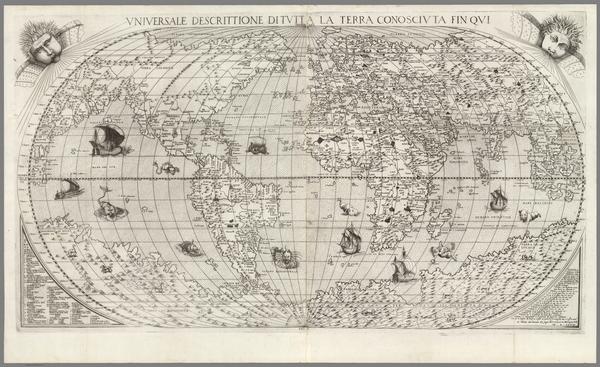
see also Maelstrom on Coronelli atlas
[ 2025-11-30 03:36:46 ]
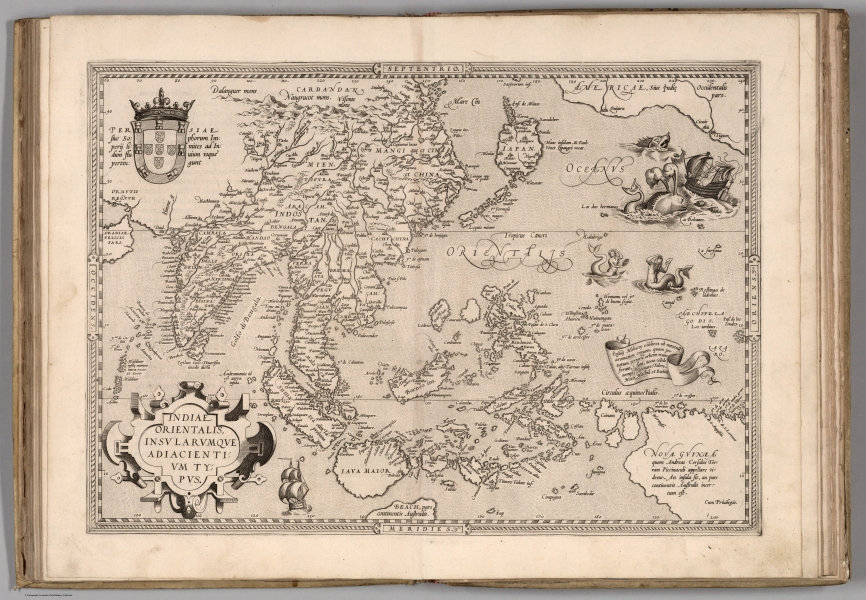
Indiae Orientalis - Abraham Ortelius - 1570
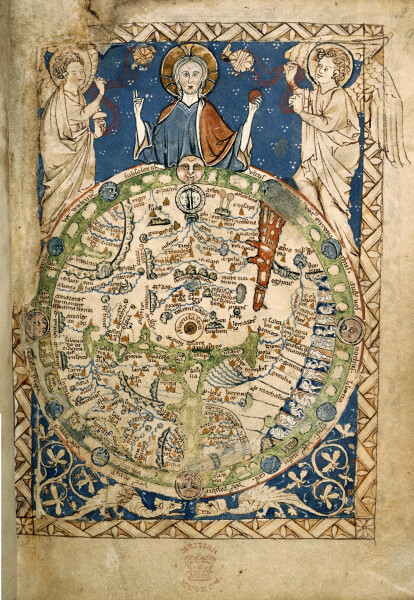
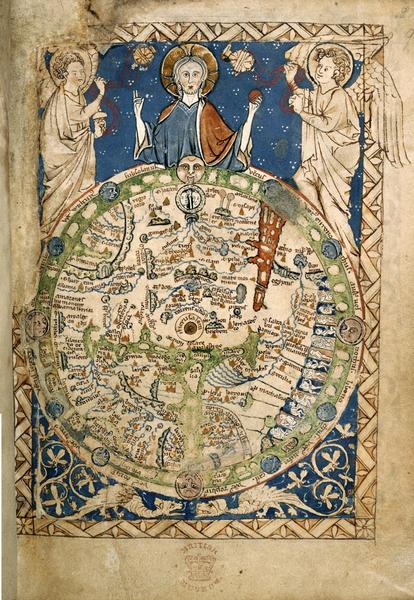
Psalter Map - artist unknown - 1265
Or, "What kind of map is this?" And you find it is a mappa mundi from the 13th century, depicting items of faith and place. You can see Jesus, Adam and Eve and the Garden of Eden, as well as Jerusalem and the Red Sea.
i38686
source: myoldmaps
perplexity |
From the late 13th century, this is the Psalter Map, because it was found a Psalter, which is book of psalms. This map is called a mappa mundi, which historian Felicitas Schmieder refers to as "Geographies of Salvation" as they report the narrative of Christ's interaction with our world. The map includes Jerusalem, the Garden of Eden, the Red Sea, the Dead Sea, Gog and Magog, as well as a section of monstrous races.
The Psalter Map is a one of the most famous examples of a midieval mappa mundi. It was likely part of a psalm or prayer book. I love it because it is only marginally geographic and instead speaks to symbols of faith and fear. It has Jerusalem in the center and the Garden of Eden. It also a section on the right of fantastic beasts from other lands.

“The Psalter map is an English map from the thirteenth century that includes much information within it's small area Like many medieval maps, this world map subjectively presents Jerusalem, as enlarged and at the center, as Jesus overlooks the world. The map also contains many indicators of the materiality of the Middle Ages, including buildings, boats, "monstrous" human races (along the right-hand side) and the wind. Thus, the map acts as a record of how people experienced the world during this time period.” History Fine Prints (on etsy)
“Psalter World Map is the name historiography gave to a medieval world map that has been found in a psalter. This mappa mundi is now conserved at the British Library in London. The small map (c. 9.5 cm or 3.7 in high) shows a lot of detail. It was written around 1260; the author is unknown. According to historian Anna-Dorothee von den Brincken, it looks like a small version of the Ebstorf Map from Northern Germany. It is a typical mappa mundi that does not only show the geographical and historical knowledge, but also puts it into the frame of salvation history. Jesus Christ appears in the East (i.e. "above"), as the maps of Christian Middle Ages have East above, not North, giving a blessing with his right hand.” wikipedia
“A psalter is a volume containing the Book of Psalms, often with other devotional material bound in as well, such as a liturgical calendar and litany of the Saints. Until the later medieval emergence of the book of hours, psalters were the books most widely owned by wealthy lay persons and were commonly used for learning to read. Many Psalters were richly illuminated and they include some of the most spectacular surviving examples of medieval book art.” wikipedia
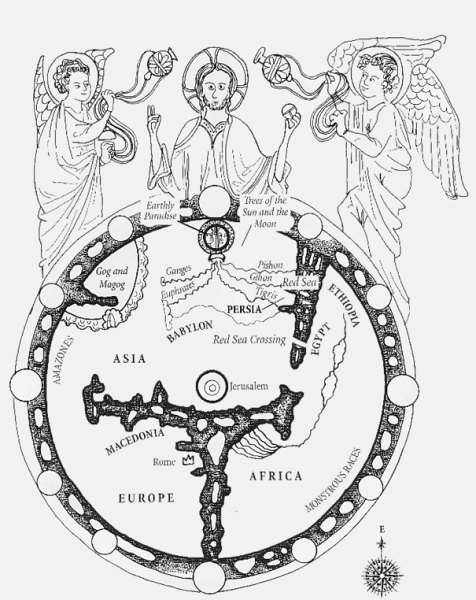
Psalter Map (Line Drawing)
But what you may not notice immediately is that it also shows the known world in the 13th century: Asia, Europe, and Africa.
source: myoldmaps.com, Jim Siebold
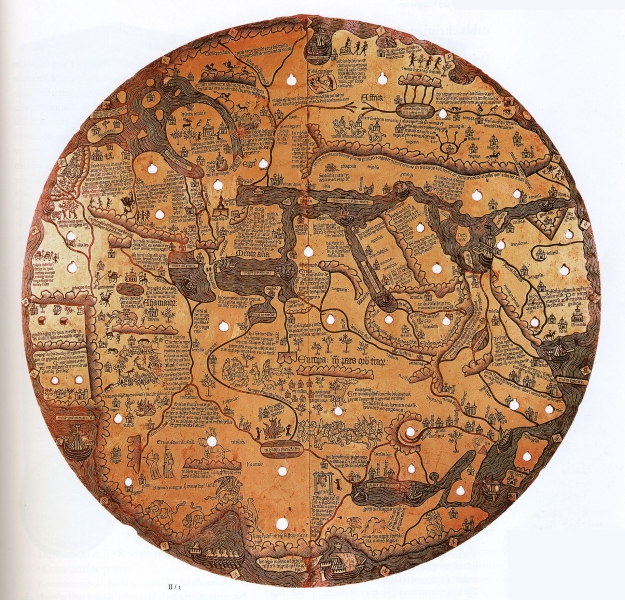
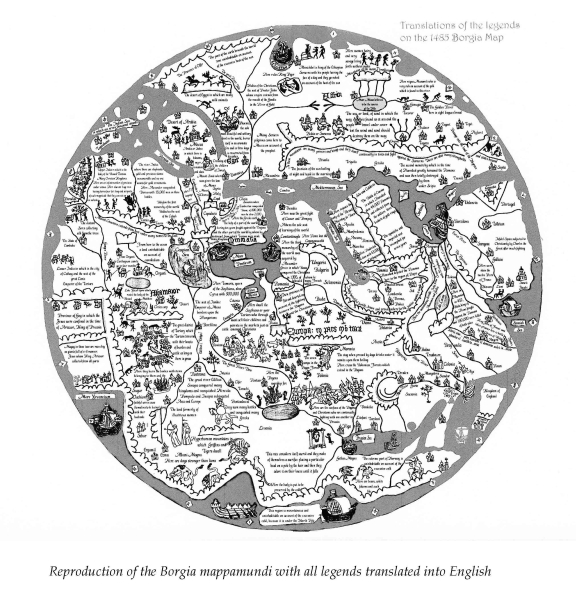
Borgia Map - 1450
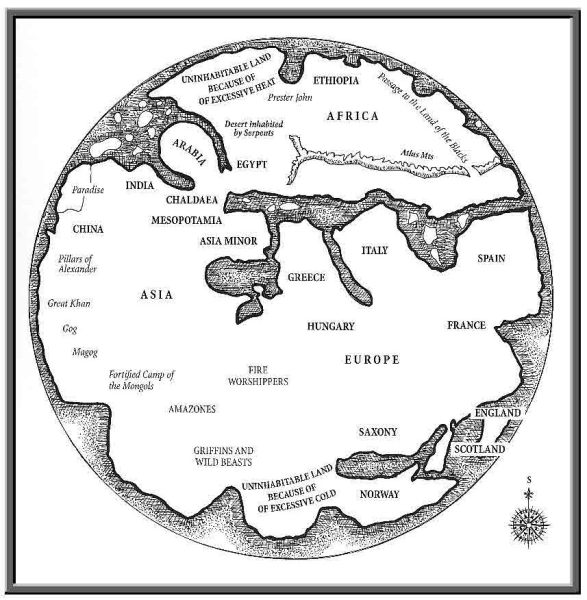
Oriented with south at the top, it depicts Europe, Asia, and Africa with dense Latin inscriptions and vignettes of peoples, animals, and marvels, reflecting a synthesis of classical learning, medieval legend, and Christian history rather than the latest nautical discoveries.blogs.loc+2
Paleographic evidence suggests it was produced in southern Germany by an unknown craftsman using niello, filling the engraved lines with dark enamel to create a striking decorative object rather than a printing plate. The absence of features such as the colonized Canary Islands, along with its historical emphasis, has led scholars to date it roughly between 1410 and 1450.wikipedia+4
The map vanished from the record until 1794, when Cardinal Stefano Borgia, an Italian antiquarian and collector, purchased it in an antique shop—often said to have been in Portugal—and installed it in his museum at Velletri, which gave the artifact its modern name. In 1797 Borgia had full‑size casts and printed facsimiles made, securing the map’s survival and its later recognition as one of the most important metalworld maps of the late medieval period.myoldmaps+3
- https://en.wikipedia.org/wiki/Borgia_map
- https://blogs.loc.gov/maps/2024/10/cardinal-borgias-unusual-map-of-the-world/
- https://www.myoldmaps.com/late-medieval-maps-1300/237-the-borgia-mappamundi/237-borgia.pdf
- https://www.mappingasprocess.net/blog/2025/2/26/materiality-and-the-limits-of-internet-research-the-borgia-map-and-its-facsimiles
- https://www.raremaps.com/gallery/detail/84631/medieval-mappa-mundi-apographon-descriptionis-orbis-ter-anonymous
- https://connectingcollections-manmel.com/borgia-mappa-mundi-long-text/
- https://www.economist.com/1843/2012/09/27/a-world-of-difference
- https://blog.geogarage.com/2022/11/the-borgia-mappa-mundi-15th-century-map.html
- https://www.facebook.com/groups/640476949304851/posts/6395922897093532/
- https://www.raremaps.com/gallery/detail/69806
- https://www.doria.fi/bitstream/handle/10024/101652/An_account_of_a_copy_from_the.pdf?sequence=1&isAllowed=y
[ 2025-11-27 05:05:25 ]
Borgia Map (Line Drawing with Translated Text)
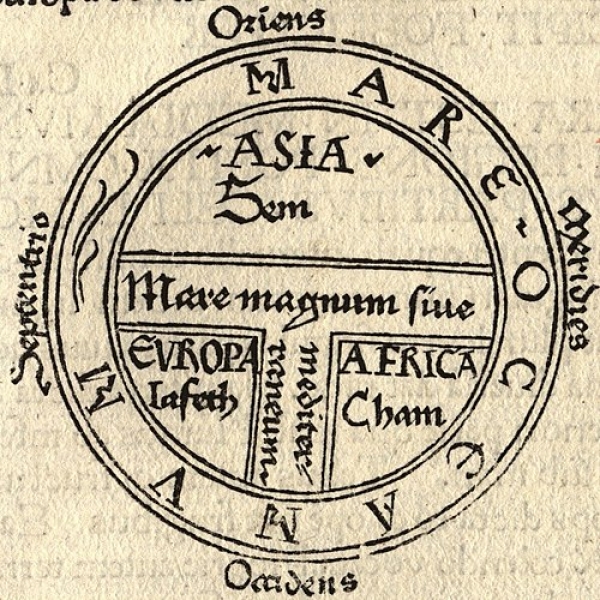
T-O Maps
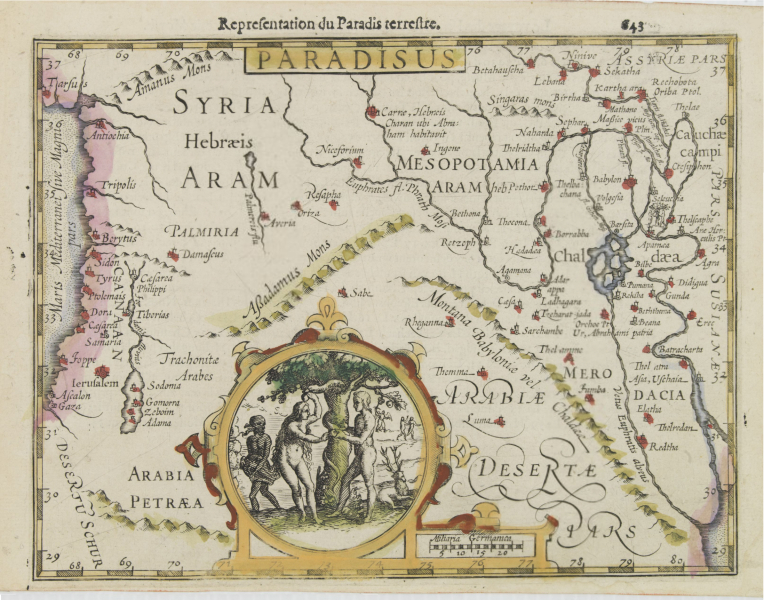
Paradise - Hondius and Mercator - 1607
https://web.archive.org/web/20100604205102/http://www.uflib.ufl.edu/maps/MAPHOLY01.HTML
[ 2025-11-30 04:23:20 ]
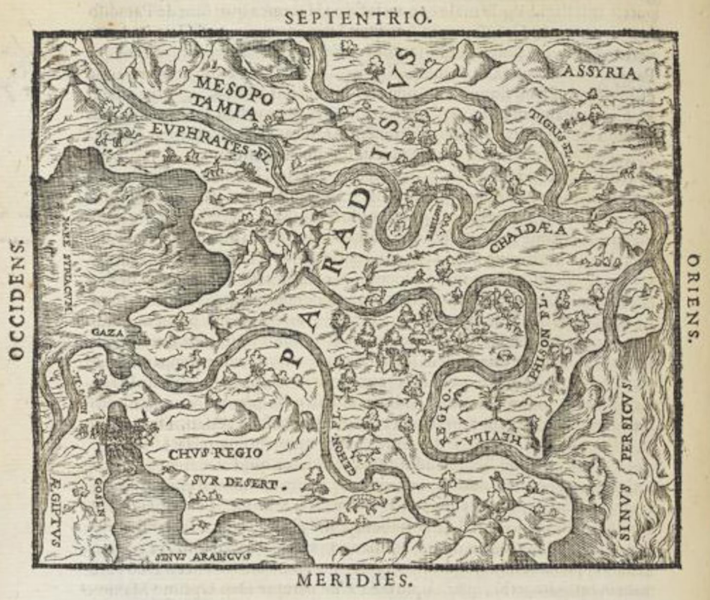
Paradise - Mathieu Brouart Beroalde - 1575
Google Books - page 88
https://www.google.com/books/edition/_/WHEssUKQKJUC?hl=en&gbpv=1&pg=PA222
[ 2025-11-27 05:36:02 ]
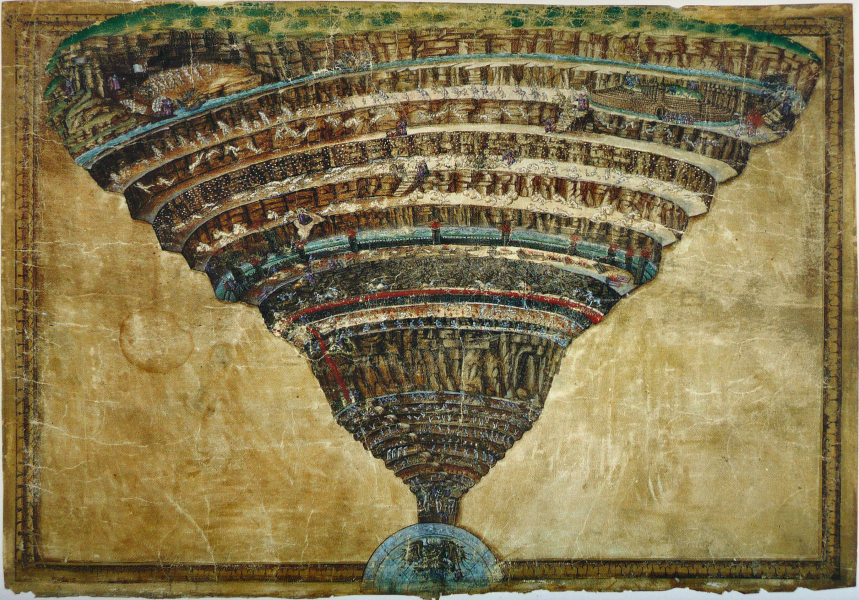
The Map of Hell - Sandro Botticelli - 1480-1490
It is a detailed illustration for Dante Alighieri's epic poem, The Divine Comedy.
Artwork Details
- Artist: Sandro Botticelli
- Work: "The Map of Hell" (La Mappa dell'Inferno or La Voragine dell'Inferno)
- Series: One of 92 surviving illustrations for an illuminated manuscript of Dante Alighieri's Divine Comedy, commissioned by Lorenzo di Pierfrancesco de' Medici.
- Date: Created between approximately 1480 and 1490.
- Medium: Ink and tempera on parchment.
- Location: The original drawing is housed in the Vatican Library in Rome. The majority of the other drawings for the series are in Berlin.
Description
The illustration depicts the physical structure and geography of Hell as described in Dante's Inferno. It is shaped like a giant inverted cone or funnel, descending in nine concentric circles to the center of the Earth.
- Structure: Each circle represents a different category of sin, with the punishments becoming increasingly severe as one moves downward.
- Dante's Journey: The drawing follows the journey of the poet Dante, guided by Virgil, through these circles.
- The Center: At the very bottom, in the innermost circle of treachery, lies Satan, frozen in ice at the Earth's center.
- Detail: The artwork is noted for its meticulous detail, with tiny figures illustrating the various torments of the damned within each stratum of Hell.
This work is considered a masterpiece of Renaissance art for its faithfulness to Dante's text and its complex visualization of the poem's narrative.
[ 2025-11-27 05:36:16 ]
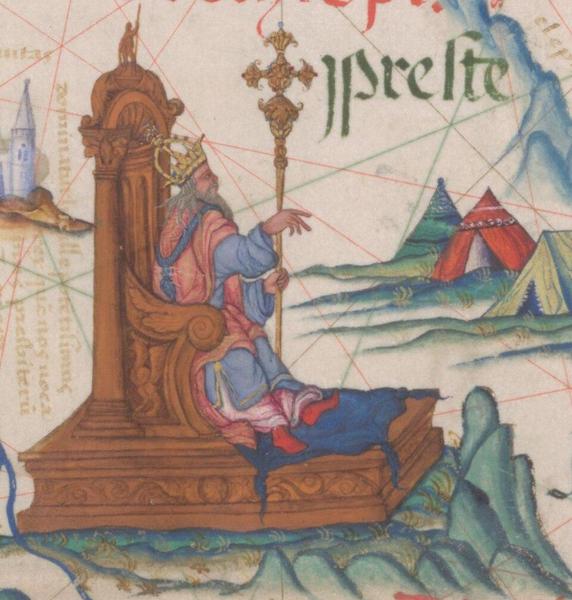
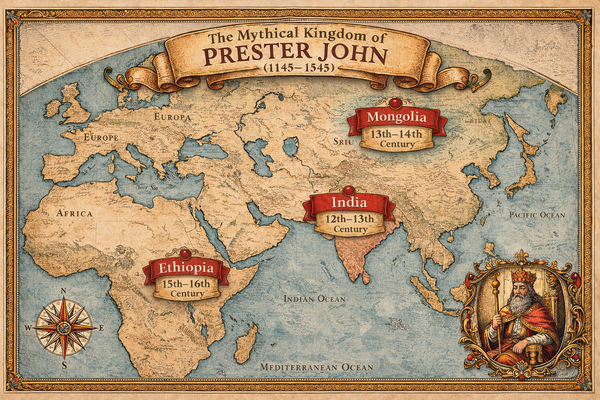
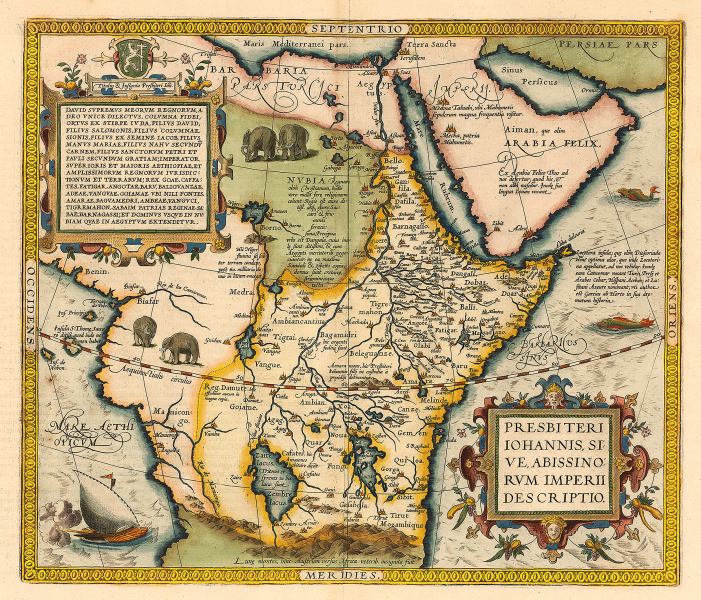
A Description of the Empire of Prester John - Abraham Ortelius - 1564
https://en.wikipedia.org/wiki/Prester_John
[ 2025-11-23 22:28:46 ]
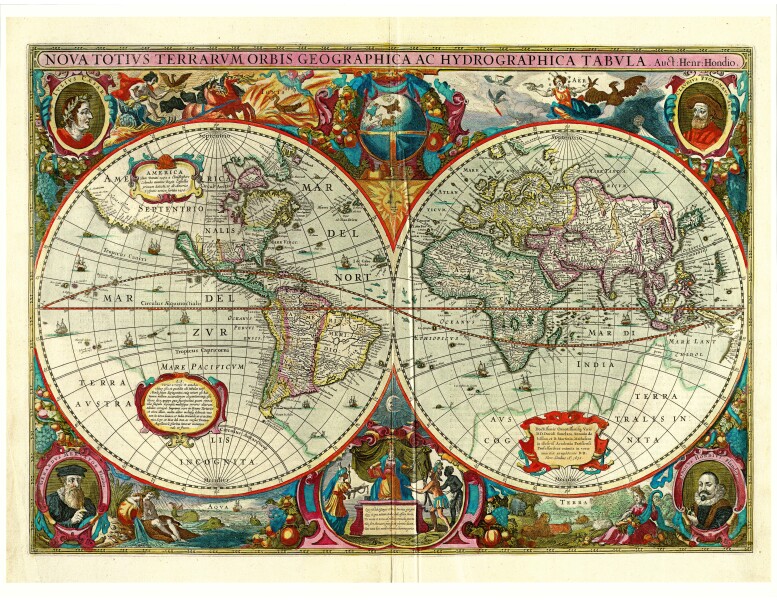
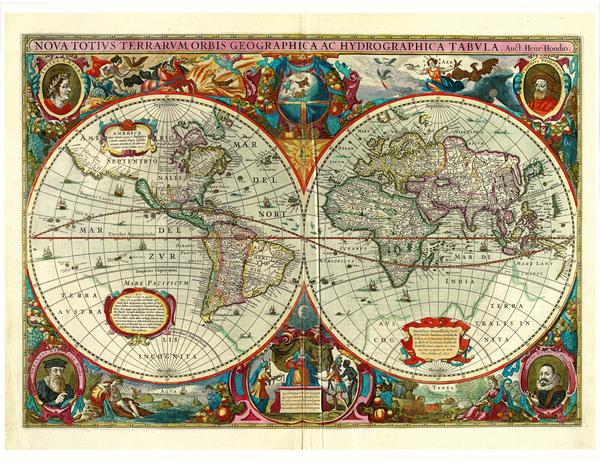
Map of the World - Hendrik Hondius - 1630
Antique maps are like supercharged nuggets of information.
One of my all-time favorite maps, by Hendrik Hondius, in 1630, during the Dutch Golden Age, when the world was not yet fully discovered and the conventional wisdom was that California was an island. It’s a map, and a piece of art and a statement about the importance of science in a world that had previously been dominated by religion and tradition.
raremaps.com (Barry Ruderman)
1636 Henricus Hondius
[English Edition!] Nova Totius Terrarum Orbis Geographica Ac Hydrographica Tabula


Hendrik Hondius (1573 - 1650) was a Dutch Golden Age engraver, cartographer and publisher. This wonderful and very detailed map was first published around 1630, in his famous atlas Atlantis Maioris. It was the first dated map published in an atlas, and therefore the first widely available map, to show any part of Australia. The map is within decorative border, with portraits of Julius Caesar, Ptolomey, Gerhard Mercator and Jodocus Hondius and tableaus depicting the 4 elements - Earth, Air, Fire and Water. Terra Incognita Maps
Nova Totius Terrarum Orbis Geographica ac Hydrographica Tabula is a map of the world created by Hendrik Hondius in 1630, and published the following year at Amsterdam, in the atlas Atlantis Maioris Appendix. Illustrations of the four elements of fire, air, water, and land are included. In the four corners, there are portraits of Julius Caesar, Claudius Ptolemy, and the atlas's first two publishers, Gerard Mercator and Jodocus Hondius, the father of Hendrik.[39] Among its claims to notability is the fact that it was the first dated map published in an atlas, and therefore the first widely available map, to show any part of Australia, the only previous map to do so being Hessel Gerritsz' 1627 Caert van't Landt van d'Eendracht ("Chart of the Land of Eendracht"), which was not widely distributed or recognised. The Australian coastline shown is part of the west coast of Cape York Peninsula, discovered by Jan Carstensz in 1623. Curiously, the map does not show the west coast features shown in Gerritsz' Caert. Wikipedia
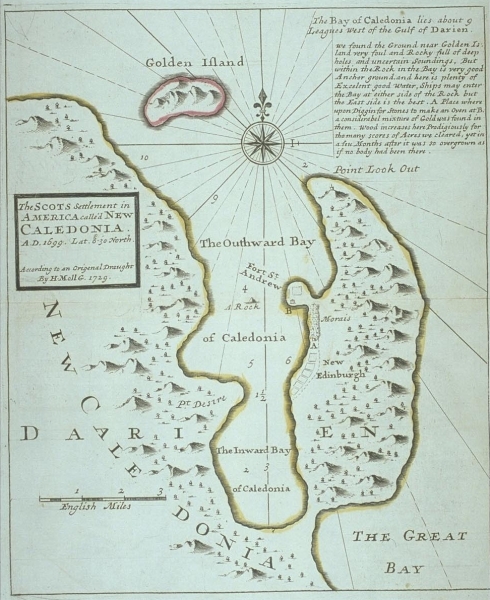
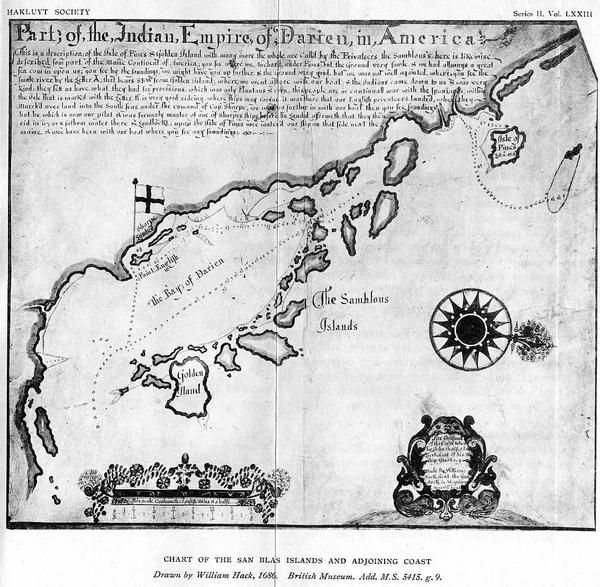
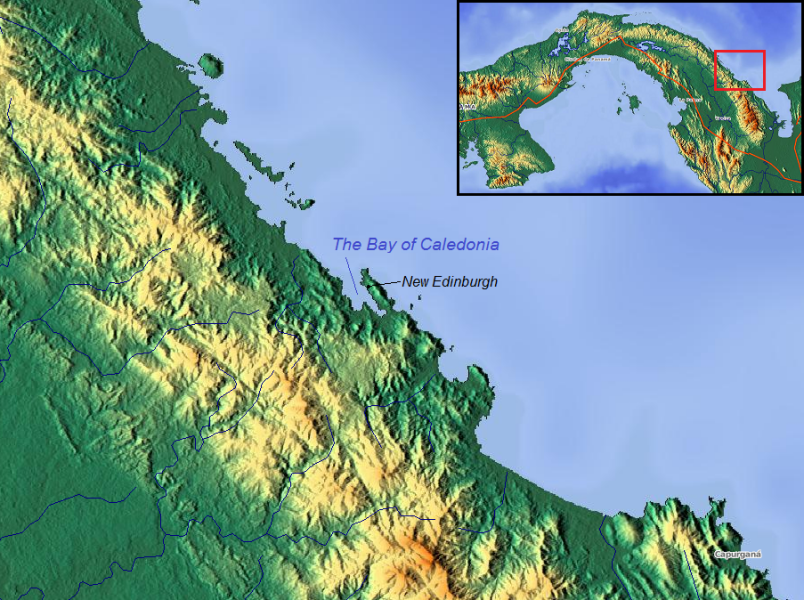
New Caledonia in Darien - Herman Moll - 1699
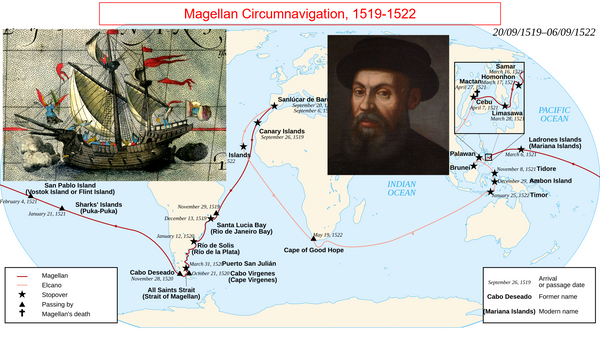
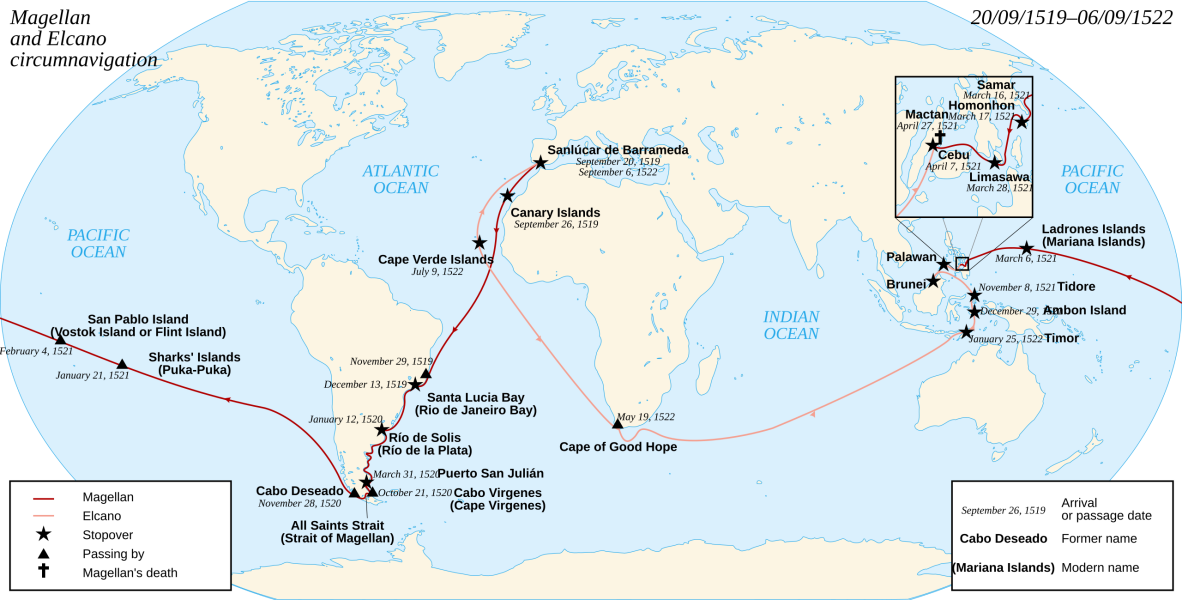
Magellan Expedition
https://en.wikipedia.org/wiki/Timeline_of_the_Magellan_expedition
[ 2025-11-30 20:02:21 ]
Cantino Planisphere - Unknown Maker - 1502
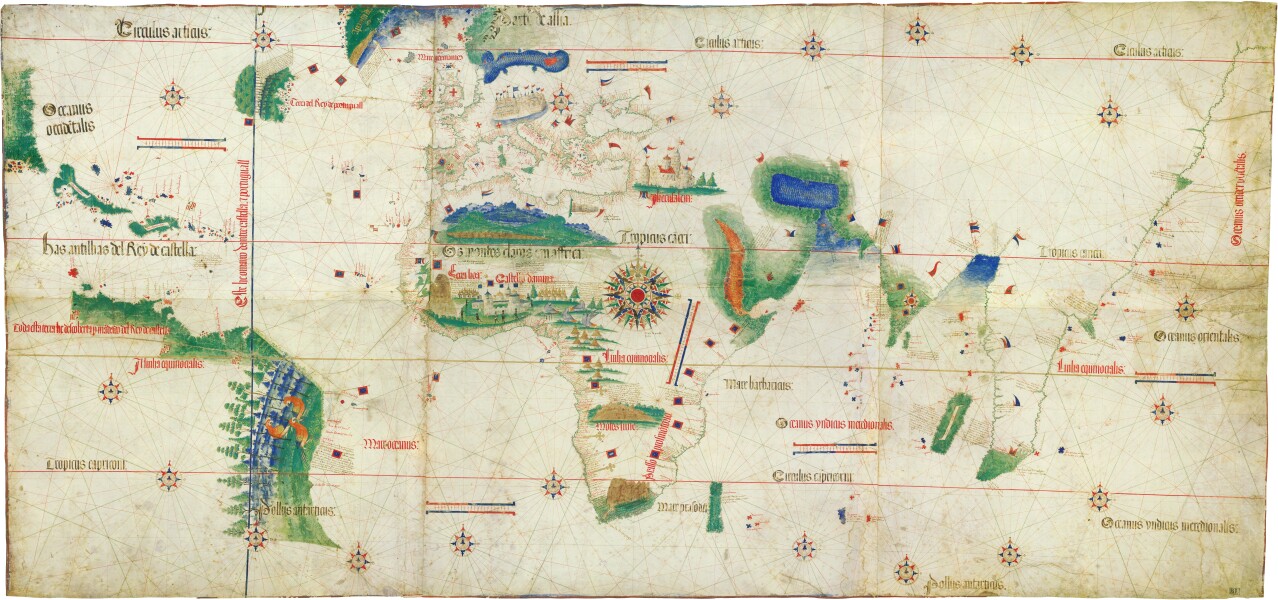
Q: What information do the Portuguese know about the world
L: Mapped using lines of latitude and longitude, meridians using rhumb lines (line that crosses meridians of longitude at the same angle)
S: sightings, compasses, information from previous exploration missions such as Colombus, Cabral, and de Gama
E: Europe and known world more accurate than newly mapped areas such as Far East Asia, Caribbean, and Brazil,
D: Hand drawn using ink, pigments on vellum (animal skin) Beautifully drawn images of trade centers like Venice and important religious cities like Jerusalem. Areas that are more detailed elsewhere represent where Portugal has explored
I: one and done. Original copy housed at Biblioteca Estense in Modena, Italy.
Link:
https://en.wikipedia.org/wiki/Cantino_planisphere
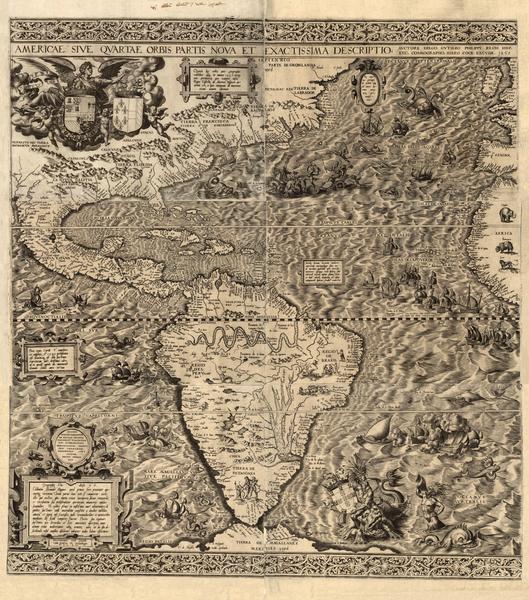
North and South America - Sebastian Munster - 1559
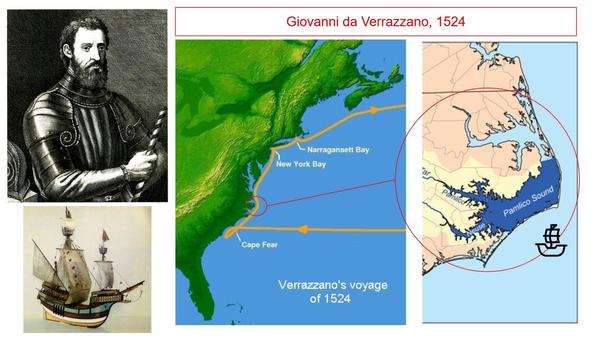
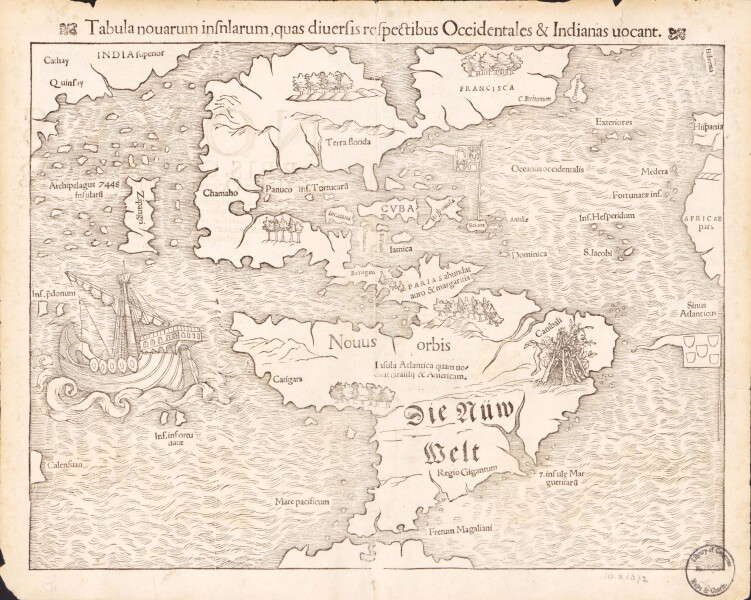
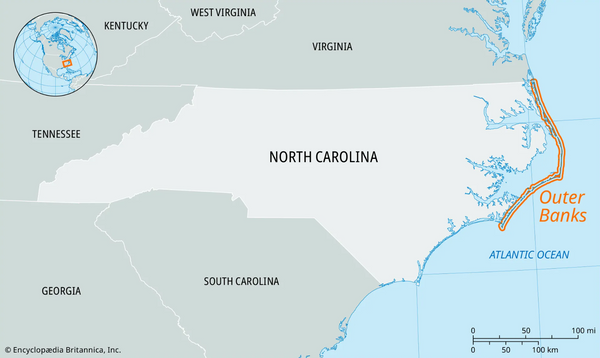
By 1559, considerably more voyages had been made to both North and South America, but things were still greatly out of focus. Verrazzano’s voyage happened in 1524 and, in one of the great geographic misconceptions of all time, Verrazzano arrived at the Outer Banks of North Carolina and thought he was looking at the Pacific Ocean. Munster drew this map according to Verrazzano’s error.


i36727i36727
“His Cosmographia of 1544 was the earliest German-language description of the world...The Cosmographia was one of the most successful and popular works of the 16th century. It passed through 24 editions in 100 years. This success was due to the fascinating woodcuts...in addition to including the first to introduce "separate maps for each of the four continents known then-- America, Africa, Asia and Europe." It was most important in reviving geography in 16th century Europe. The last German edition was published in 1628, long after his death...He died at Basel of the plague in 1552.” wikipedia.org
"Excellent example of the earliest separate map of the entire Western Hemisphere. This was also the earliest map to refer to the Pacific Ocean (along with Munster's world map) by a variant of its present name, Mare pacificum. It was one of earliest acquirable maps to show Japan prominently, which is depicted as a large single island called Zipangri (after Polo) just off the coasts of California and Mexico. The depiction of North America is dominated by one of the most dramatic geographic misconceptions to be found on early maps--the so-called Verrazanean Sea. On the map, the Pacific Ocean cuts deeply into North America so that there is only a narrow isthmus between the Atlantic and Pacific oceans. This resulted from the voyage of Verrazano, who mistook the waters to the west of the Outer Banks, the long barrier islands outlining the North Carolina coast, as the Pacific Ocean. The division of the New World between Spain and Portugal is recognized on the map by the flag of Castile planted in Puerto Rico, here called Sciana.”Martaya Lan
https://www.loc.gov/item/2005630225/
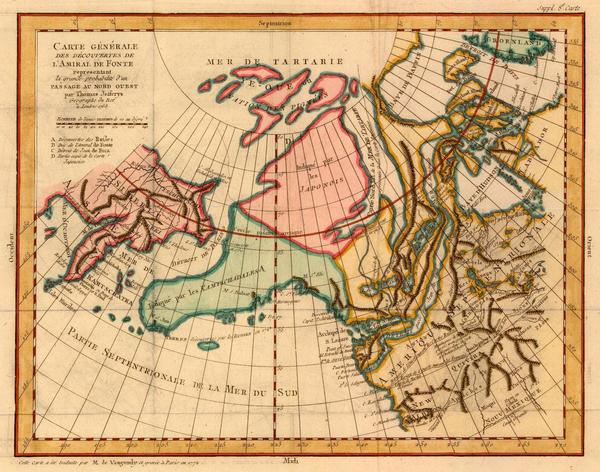
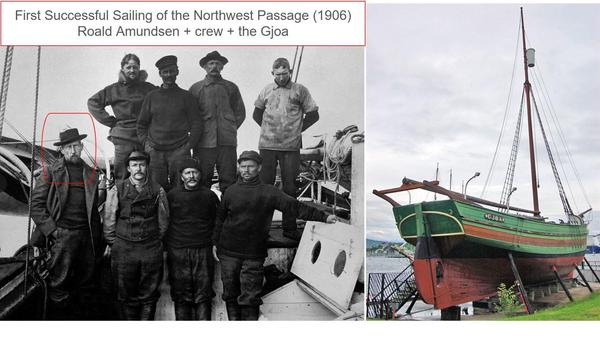
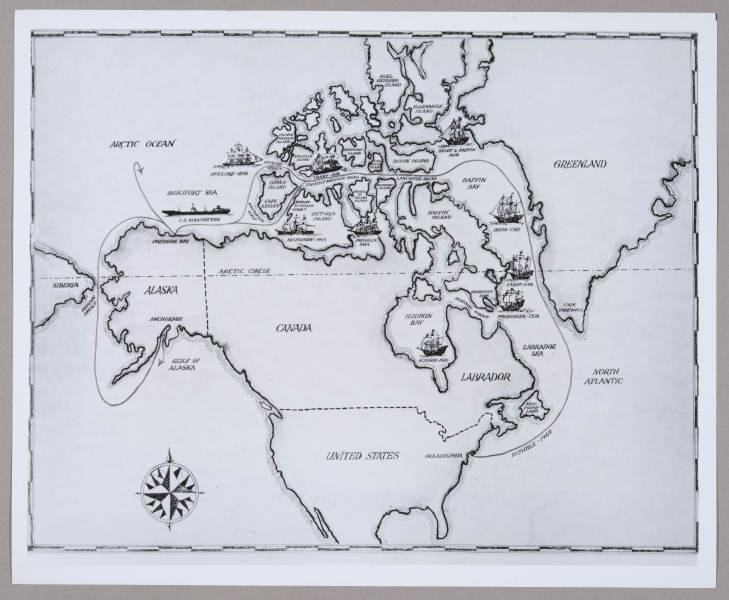
Expeditions to Find The Northwest Passage
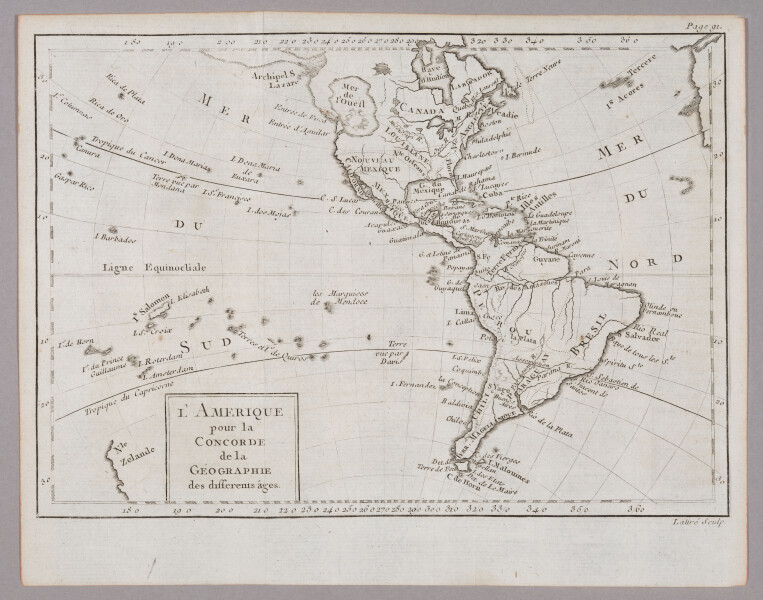
North and South America - Noël-Antoine Pluche - 1764-1772
"Sea of the west" .
This map is an antique map of the Americas titled "L'Amerique pour la Concorde de la Géographie des différents âges" (America for the Concordance of Geography of Different Ages), created by Noël-Antoine Pluche. It was published in his work Concorde de la Géographie des différens âges, with various editions released around 1764 and 1772.
Key Details
- Maker: Noël-Antoine Pluche (or Abbé Pluche).
- Year: Circa 1764 or 1772, predating Captain Cook's significant voyages.
- Content: The map provides a historical look at geographical knowledge of the time. It is notable for its depiction of geographical misconceptions prevalent in the 18th century, such as:
- A large, mythical "Sea of the West" (Mer de l'Ouest) in the Pacific Northwest.
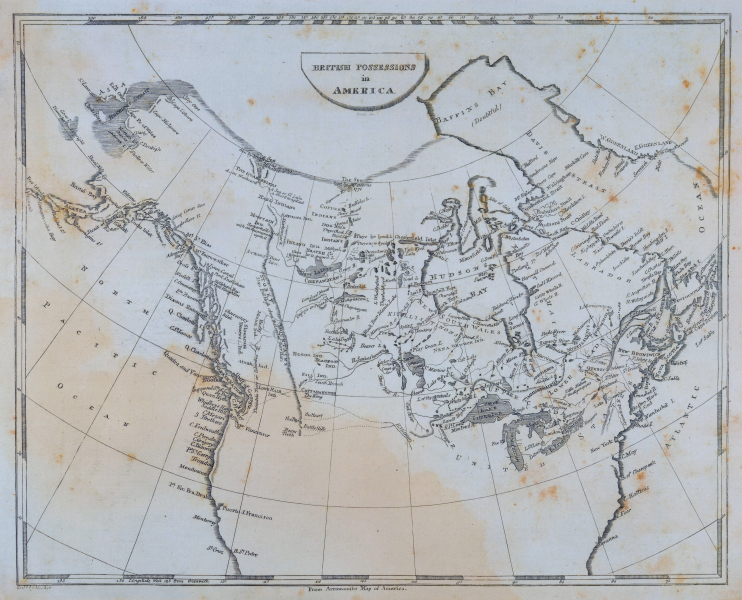
British Possessions in America - Thomas and Andrews - 1805
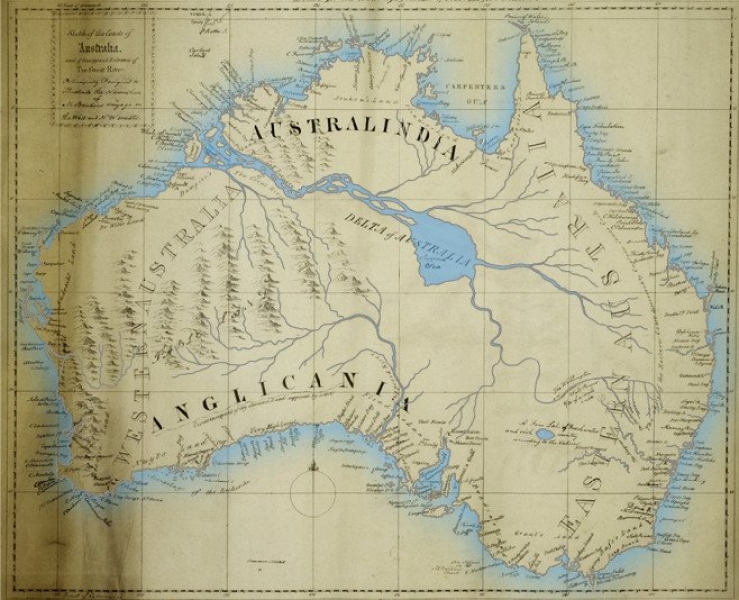
Australia's Inland Sea - Thomas J. Maslen - 1827
It depicts a hypothetical geography, most notably featuring a large inland sea and river system that does not actually exist.
Key Details of the Map
- Creator and Date: Thomas J. Maslen, published around 1827 and included in his 1830 book The Friend of Australia.
- Fictional Geography: The map presents a theoretical "Delta of Australia" and "Great River" flowing from the interior to the northwestern coast and into the Indian Ocean. This idea was an extrapolation based on the discovery of the Macquarie and Castlereagh Rivers by earlier explorers, which were mistakenly believed to be the headwaters of a major inland system. Later explorations disproved the existence of this inland sea and river.
- Regional Names: Maslen assigned speculative names to different parts of the continent, including:
- Australindia: The northern part of the continent.
- Anglicania: The southern part of the continent.
- Historical Context: In the early 19th century, much of Australia's interior was still unknown to European explorers, leading to various theories and speculative maps. Matthew Flinders was the first to circumnavigate the continent and popularize the name "Australia," but this was some years before Maslen's map was created. The British formally adopted the name Australia in 1824.
This map serves as a fascinating example of historical geographical myths before the continent was fully explored and accurately charted.
https://bigthink.com/strange-maps/140-the-great-australian-inland-sea/
https://www.maptorian.com/an-imaginary-inland-sea-in-australia/
[ 2025-11-23 22:20:09 ]
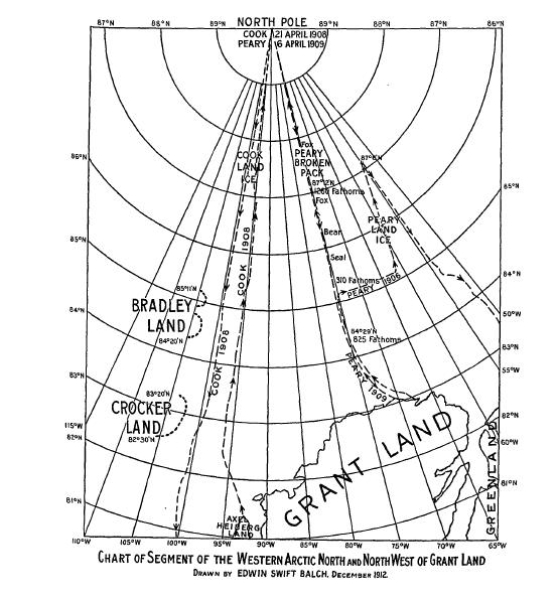
Map of Supposed Crocker Land and Bradley Land - 1912
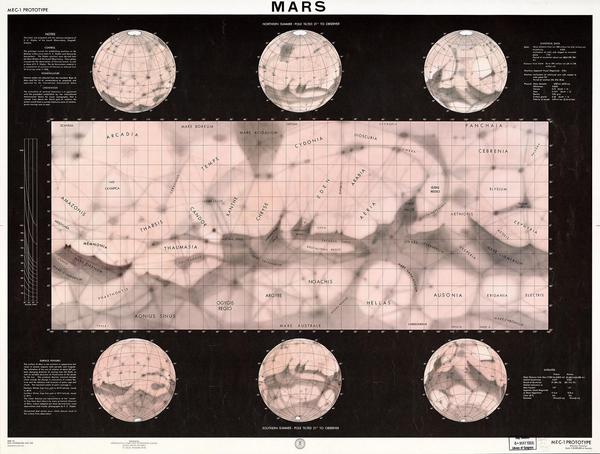
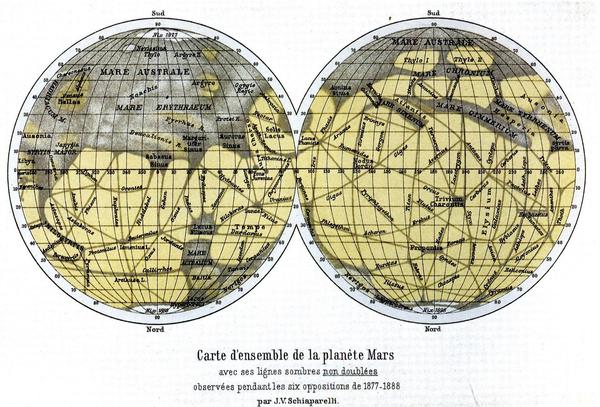
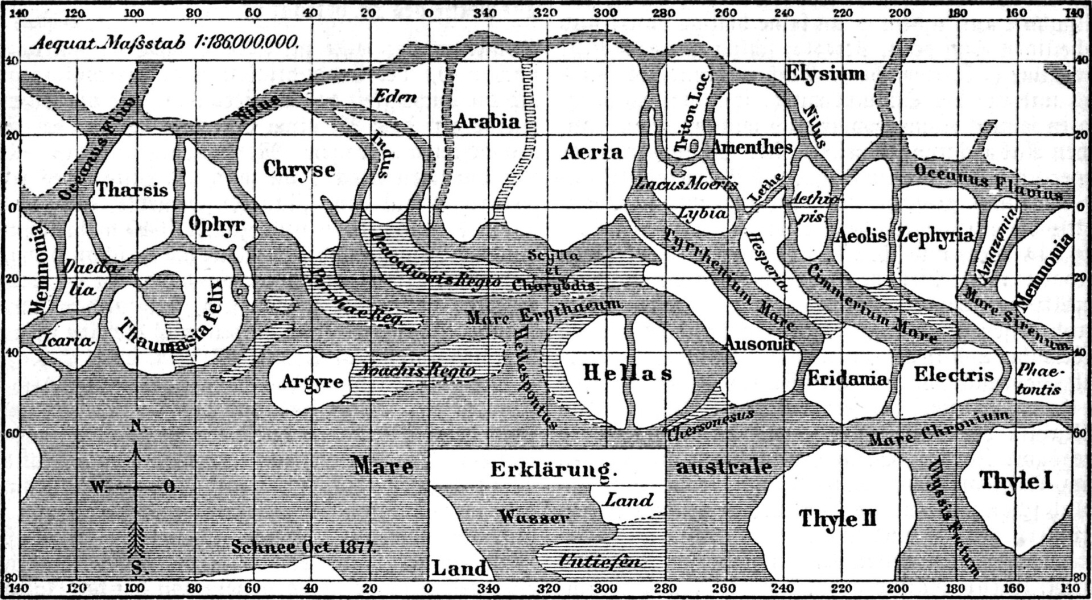
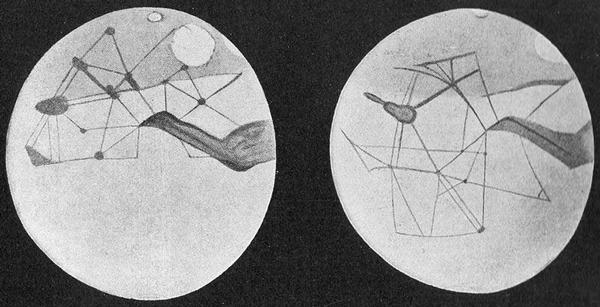
Mars - Giovanni Schiaparelli - 1877
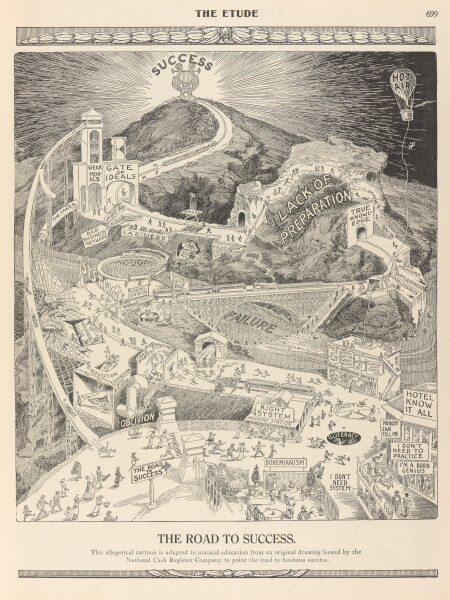
The Road to Success - Etude Magazine - 1913
An allegorical map of the road to musical success. A host of shortcomings and mistakes including "Bohemianism," "Misrepresentation", "Lack of Preparation", "Bad Business Methods", and "Weak Morals" lead to "Oblivion", and the "River of Failure". But those who adopt the "Right System", attain "True Knowledge", and pass through the "Gate of Ideals", the golden lyre of Success beckons. The map "is adapted to musical education from an original drawing issued by the National Cash Register Company to point the road to business success." A copy of the NCR map can be found at http://chroniclingamerica.loc.gov/lccn/sn89081022/1913-10-22/ed-1/seq-6.pdf
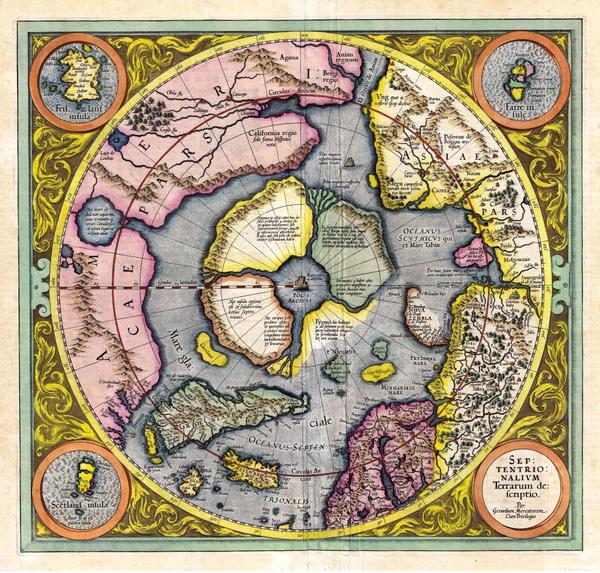
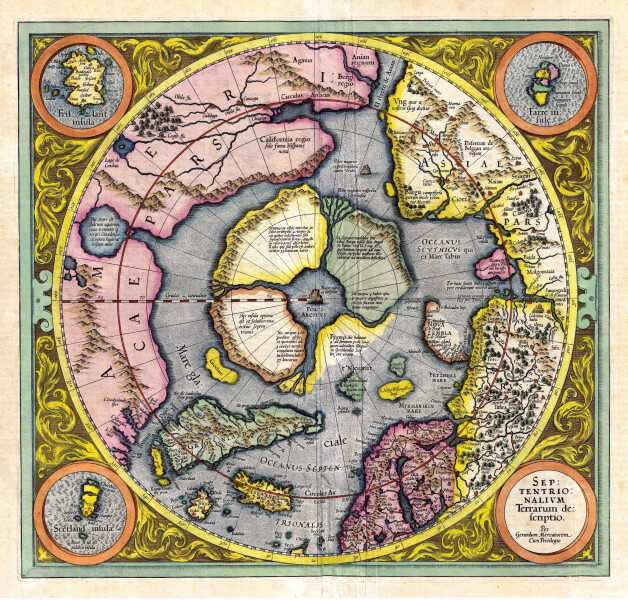
The North Pole - Gerhard Mercator - 1595
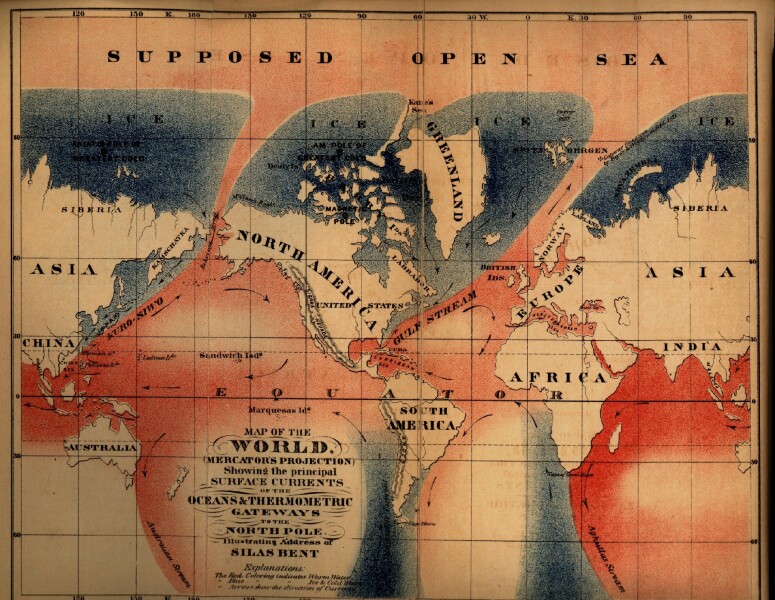
Open Polar Sea - Silas Bent - 1872
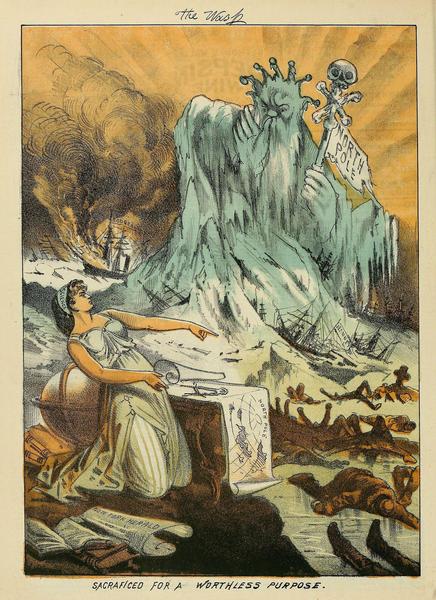
“The Open Polar Sea was a hypothesized ice-free ocean surrounding the North Pole. This unproved and eventually-disproved theory was once so widely believed that many exploring expeditions used it as justification for attempts to reach the North Pole by sea or to find a navigable sea route between Europe and the Pacific across the North Pole.” Wikipedia
“The theory that the North Pole region might be a practical sea route goes back to at least the 16th century, when it was suggested by Robert Thorne. The explorers William Barents and Henry Hudson also believed in the Open Polar Sea. For a time, the theory was put aside because of the practical experience of navigators who encountered impenetrable ice as they went north. However, the idea was revived again in the mid-19th century by theoretical geographers, such as Matthew F. Maury and August Petermann. At the time, interest in polar exploration was high because of the search for John Franklin's missing expedition, and many would-be polar explorers took up the theory, including Elisha Kent Kane, Dr. Isaac Israel Hayes, and George Washington De Long. It was believed that once a ship broke through the regions of thick ice that had stopped previous explorers, a temperate sea would be found beyond it.” Wikipedia
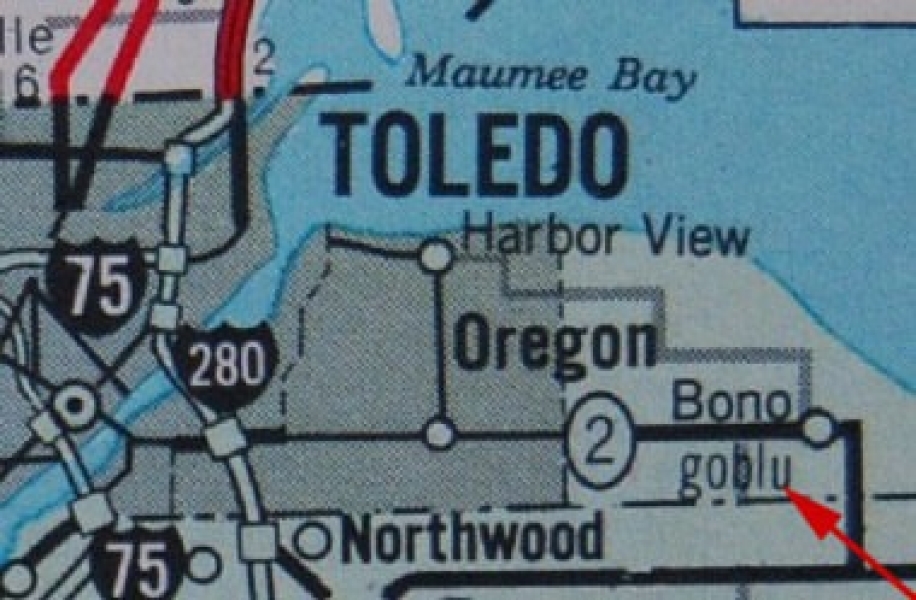
Map of Michigan (Goblu) - Peter Fletcher, State Highway Commission - 1978-1979
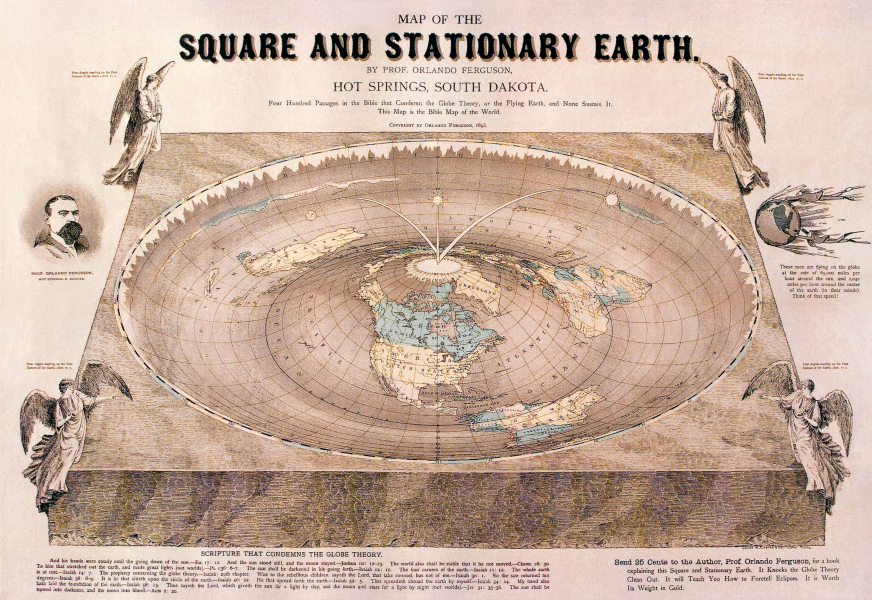
Flat Earth map - Orlando Ferguson - 1893
https://en.wikipedia.org/wiki/Flat_Earth
[ 2025-11-30 20:06:46 ]
Place a DOT on the image