Passion & Conflict: Islamicate Maps of the Maghrib / ‘the West’ (Iberian Peninsula and North Africa)
Step 0 of 0
1
2
3
4
Leiden KMMS 3101 Maghrib Map
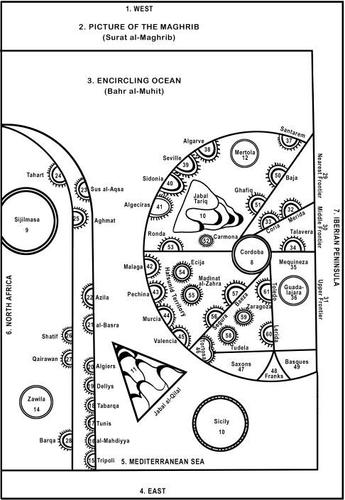
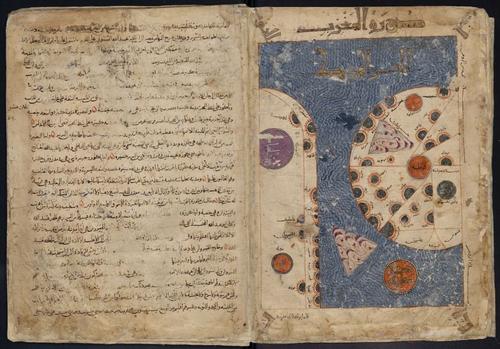
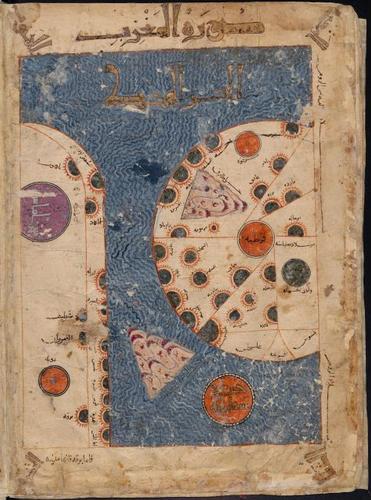
“Ṣūrat al-Maghrib” = Picture of the Maghrib (North Africa and Iberian Peninsula). Source: Leiden: Bibliotheek der Rijkuniversiteit, Or. 3101, Eastern Mediterranean (589 AH/ 1193 CE), fol. 20
Academic Image Description:
This medieval Islamic representation of the Mediterranean is classified as a late 12th century work of medieval Sicilian provenance. It is from an Arabic geographical manuscript titled Kitab al-masalik wa-al-mamalik ascribed to Abu ‘Abbas Ahmad ibn Ibrahim al-Istakhri al-Farisi. The colophon of the manuscript provides a firm date of Rabi‘ I 589 A.H. (April 1193 C.E.) This manuscript is housed in Leiden at the Bibliotheek der Rijkuniversiteit, Cod. Or. 3101. The map is located on folio 20a.
Click on the the Show Dots button (image below) to find a guided tour through this map by Professor Karen Pinto

After that, click on the Dot Story entitled "Title?? by Karen Pinto.”
Surat al-Maghrib = Typical Medieval Islamicate map of ‘the West’ — i.e. Iberian Peninsula and North Africa
At first glance the typical medieval Islamicate map of ‘the West’ —Surat al-Maghrib—strikes us as nothing more than a quaint abstraction of circles, triangles and oblong shapes ornately adorned with vivid pigments. Closer study presents a more complex image, however, of passion and conflict; of attraction and revulsion; of love and hate. Indeed, the Maghrib map is by far the most dissonant image in the extant collection of medieval Arabic and Persian maps and, as such, one of the most engaging. Whereas all the other images have a veneer of harmony and balance, this one is—by deliberate design—passionately conflicted. It is the discord of desire inlaid within the Muslim pictographs of the Maghrib that is the focus of this chapter, the over-arching question being how did medieval Islamic cartographers settle on such a strange-looking image as a representation of the western Mediterranean– in particular, North Africa, Islamic Spain, and Sicily? Answering this question requires immersing ourselves in the map-image itself, and takes us through a series of subliminal messages ranging from intra-Islamic imperial ambitions to erotic and nostalgic Andalusian poetry.
Place a DOT on the image