HIST23A - Student Projects - January 2023
Step 0 of 0
1
2
3
4
5
6
7
8
9
10
11
12
13
14
15
16
17
18
19
20
21
22
23
24
25
26
27
28
29
30
31
32
33
34
35
36
37
38
39
40
41
42
43
44
45
46
47
48
49
50
51
52
53
54
55
56
57
58
59
60
61
62
63
64
65
66
E316 - map projections - daniel huffman - 2022
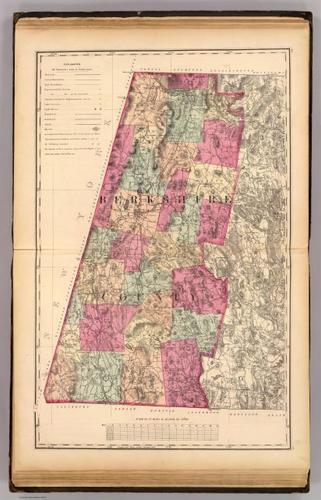
E316 - Berkshire County - H.F. Walling - 1871 (Joseph Grillo)
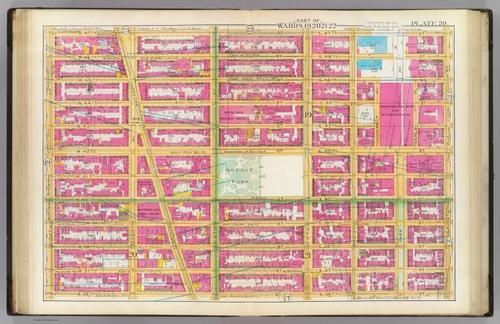
E316 - Wards 19-22 - Geo. W. & Walter S. Bromley - 1891 (Jacob Cohen)
Q: What buildings are in the depicted area?
L: Oriented with NYC's grid and centered on Bryant Park
S: Surveys and official plans by civil engineers
E: Probably some building dimensions and true water main locations
D: Lithographed map
I: One and done?
by Jacob Cohen
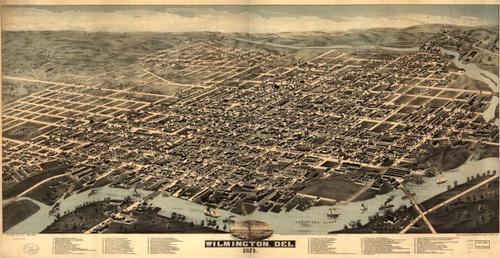
E316 - Wilmington, Del. 1874. - H.H. Bailey & Co. - 1874 (Donnie Morton)
- What does Wilmington look like from above?
- Like looking at the city from a hot air balloon/helicopter
- Sighting
- Some distances are probably estimated
- Design is similar to a painting or art piece as opposed to practical map
- One and Done
by Donnie Morton
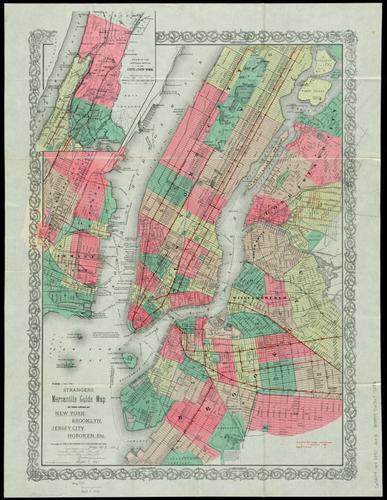
E316 - Strangers Mercantile Map of NY, BK, Jersey City, Hoboken, etc - G.W. & C.B. Colton & Co - 1890 (Audrey Liu)
Source: Boston Public Library
https://collections.leventhalmap.org/search/commonwealth:4m90f2794
Q - What information did 1890-era merchants need to navigate modern day-NYC harbors?
L - Centers most detail around large harbors of Hoboken, Jersey City, Manhattan, and Brooklyn
S - sightings, compass, preexisting maps + numbering systems
E - accuracy and detail is mostly concentrated around the harbors. Accuracy is pretty good (reflects different features/names from the modern ones)
D - typed and printed, in color, some details might be hand-drawn
I - Only iteration that I'm aware of
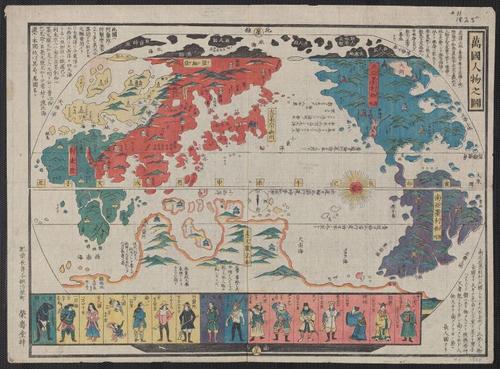
E316 - Picture of the World and its People - Bangkok Jinbutsu - 1825 (Ryan Guo)
Q - What do the people from different parts of the world look like?
L - The continents are aligned with an enlarged Japan as the center; continents are color coded
S - Sightings, firsthand accounts of what foreigners looked like
E - Coastlines estimated, some notes on landmarks, estimated what a stereotypical person from a particular nation would look like
D - Hand drawn, written in Japanese, row of people fills spot, issued as an early Nagasaki print
I - One and done
Bankoku Jinbutsu no Dzu. [Picture of the World and its People].
Published by Eijudo, Imakajiyamachi,
Map in Japanese. Originally issued as one of the earliest Nagasaki prints in mid-eighteenth century.
Preliminary record.
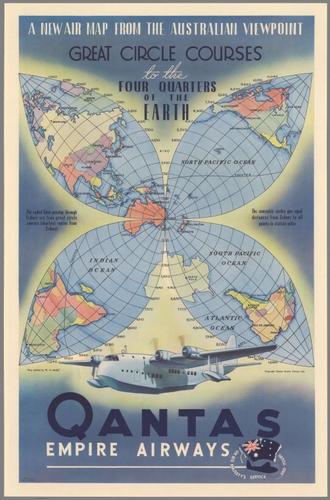
E316 - Qantas Airlines promotional map, Rhys Williams, 1938 (Harry Letterman)
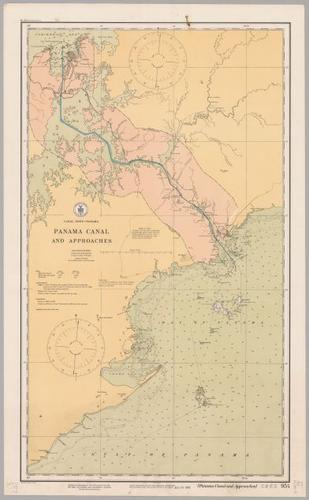
E316-Panama Zone-US Coast and Geodetic Survey-1914 (Simon Kent)
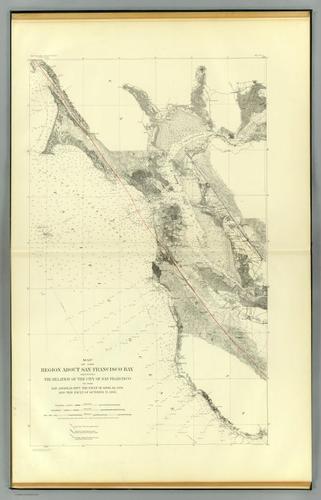
E316 - San Francisco Bay showing San Andreas Rift - California State Earthquake Investigation Commission - 1908 (Spencer Huang)
Q - How is the Bay Area positioned relative to the San Andreas Fault?
L - Facing northwards. Fault is the central feature, not the Bay.
S - Observation via sight (land contours) and sounding (oceanic contours)
E - Large areas of Northern California are left blank; Depth of the SF Bay is approximated in various areas.
D - A color map with relief shown by contours and spot heights and depths depicted by soundings and isoline.
I - Atlas created as part of the report for the California State Earthquake Investigation Commission following the deadly 1906 earthquake.
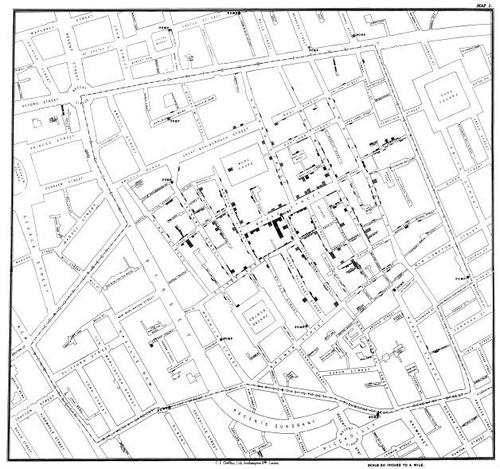
E316 - “On the Mode of Communication of Cholera” - John Snow - 1854 (Annie Gustafson)
Q - Can mapping deaths and water pumps provide evidence to support the miasma or germ theory of cholera spread?
L - Plot residences of the recently deceased on the same map as the locations of water pumps.
S - Snow tracked information from hospitals and public records to plot deaths and residences.
E - Inevitable estimation in any hand-drawn map, trust that data is accurate.
D - Hand-drawn–labels roads, water pumps, and deaths (via hash marks) because locations, water sources, and deaths are relevant to answering the question.
I - One and done.
Voronoi diagram of the map, courtesy of John Jungck: 
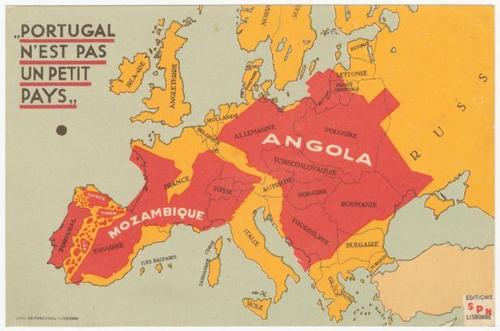
E316-Portugal n'est pas un petit pays-Galvao-1934 (Josh Rubel)
Q-How much colonial land does Portugal actually control?
L-Aligned like most maps are, but with the colonial possessions of Portugal overlaid onto the rest of Europe
S-Past Maps? Unsure, doesn't seem to be focal point
E-Coastlines estimated, no cities, country names take up a majority of the space
D-Color printing made for postcards
I-Mass produced, used as pro-imperialism propaganda
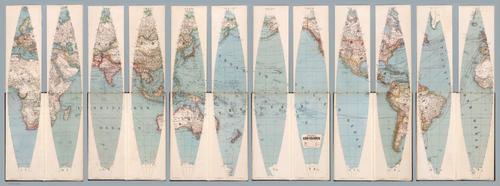
E316 - Composite Map: Henze's Erd-Globus - Adolf Henze - 1891 (Bradley St. Laurent)
Title / Cartographer / Year / Source: Hense's Erd-Globus (Earth Globe), Adolf Henze, 1891, David Rumsey Map Collection
Question: Gather Germany's current knowledge of the World---especially in regard to geopolitical and economic aspects---and present it in globe form.
Logic: to avoid the hassle of projecting a sphere onto a two-dimensional plane, Henze instead chooses to produce a map in globe form. The photo shown here is the globe prior to being glued onto the actual globe. Each strip is called a gore, and the 12 gores connect to create the sphere of the Earth when put together.
System: The data for the map was likely built upon knowledge gathered by German explorers and cartographers over time, and intelligence gathered through working with other nations, as well as information gathered during wars or military expeditions. By this time in history, knowledge of global geography and the like would have been fairly well-known and agreed upon among countries, especially one as influential as Germany.
Estimation: A very interesting thing about this map is in the legend, where Henze denotes “die Zahlen an den Seewegen bezeichnen die Fahrzeit in tagen un stuten,” or "the numbers on the sea routes indicate the journey time in days and hours"." These travel times are surely estimations, for there are hundreds of routes of various distances marked on the map. United States is also longer and shorter than we tend to think of it.
Design: The map is designed with economic and political details in mind. Trade routes are present throughout, as well as “iron railroads" and telegraph lines sprawling across land and seas, respectively. The map was clearly manufactured for Germans involved in trade and politics, as Germany is centered on one gore, while Britain, which we might normally think of as centered due to the Prime Meridian, is split across multiple gores.
Iteration: Surely one of numerous maps produced for the German Empire, especially during this time of expansion.
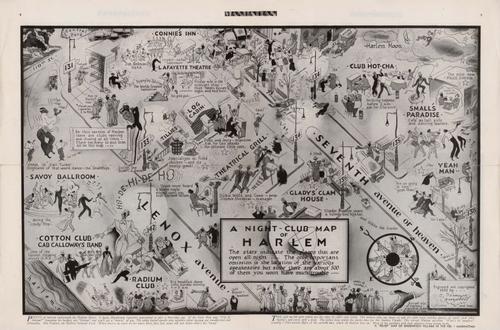
E316 - A Night-Club Map of Harlem - Elmer Simms Campbell -1933 - (Chiaka Leilah Duruaku)
https://www.loc.gov/item/2016585261/
This map acts as an playful, cartoonish pictorial of 110th to 142nd Street, possibly directed towards tourists. And so, cartoonist E. Simms Campbell draws an illumination to the bustling and mysterious ecosystem of Black Harlem night life. There was most definitely much to be heard of the attractions and vices of Harlem in the 1930s, so this small-scale map dispels some curiosities through explanation.
Could be 1932, or 1933.
Interestingly, I find that the map operates on a sort of insider knowledge (Caribbean accents, the eternal Harlem question, buying reefer, Crab Man, the Harlem Moon, "ask for Clarence") which only urbanites could truly understand. Starred locations are open 24hrs, and some locations are paired with the names of club/restaurant proprietors. Something that attracts me to this map, other than the whimsical illustrations and focus on Black New Yorkers, is the imposed character of the map. Many maps feel like they carry personality, and the inclusivity of this map makes it feel friendly. As this map was published in a periodical on 1/18/1933, I wonder what many Harlem New Yorkers thought of the night club exposure/characterization.
As this map focuses on painting several scenes more than displaying distance, so Campbell likely conducted data collection via field studies/other people's characterizations. Campbell was bon in M.O. but lived in White Plains, NY for many years.
I don't believe the estimations are accurate in connection to distance.
Character and movement is paired with map practical use. Streets are labeled and drawn with people and cars. Locations are accompanied by warnings or welcomes. A compass is added, with synchronized men on it. There are scores of people drawn, each dressed in coats and playfully in action with possible stories implied.
Through this, Elmer Simms Campbell somewhat romanticizes the section of Harlem from 110th Street (Central Park) to 142nd Street and welcomes newcomers in. Anyone confused or lost will not only know where to go, but how to operate in order to assimilate and thrive. To me, this addition makes this far more than a map.
Some of his other work:
- https://www.google.com/search?q=e+simms+campbell&source=lnms&tbm=isch&sa=X&ved=2ahUKEwio6fHurb38AhU-FlkFHbtFDIoQ_AUoAXoECAIQAw&biw=1440&bih=821&dpr=2#imgrc=B_Yp7rY4j0wWbM
- https://www.google.com/search?q=e+simms+campbell&source=lnms&tbm=isch&sa=X&ved=2ahUKEwio6fHurb38AhU-FlkFHbtFDIoQ_AUoAXoECAIQAw&biw=1440&bih=821&dpr=2#imgrc=tDnNME2xFLshAM
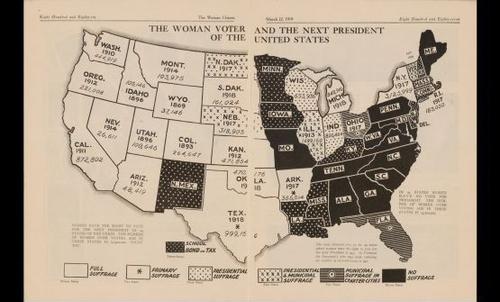
11670-E-316-The Woman Voter and The Next President (Stone Murphy)
https://digital.library.cornell.edu/catalog/ss:3293843
Q. This is a political persuasion map from the PJ Mode collection that shows the United States in 1919. Alaska and Hawaii are not included because they were not states. This map answers a few questions about how enfranchised women would impact the next presidential election.
- What is the total number of disenfranchised, but eligible female voters compared to the total number of enfranchised female voters? (popular vote metric)
- In which states are women enfranchised? (electoral college metric)
- What level of suffrage has been achieved per state? (seven categories)
L. This is a standard political map of the United States. It is based off the way the United States appears in the mercator global map projection but appears a bit more cartoonishly designed. The orientation is due north and there are is no emphasis on particular geographic features (ports, topography, landmarks).
S. The system is where this map gets interesting. In order to answer the questions, the map has the following features:
- For each state; the number of voters, year of ratification (if possible), and a category classification of suffrage.
- States in white have full suffrage, while states in black have presidential suffrage. Some states allow the right to vote in some elections, but not others (see pin 3).
- A total count on the right side of the map places the number of disenfranchised women at 14.5 mil. The number of enfranchised women is listed on the left at 12.5 mil.
- A total count of states experiencing suffrage at each category.
E. This map is an estimation of what is at stake for women in the fight to secure voting rights. It also informs the pro-suffrage readers of The Woman Citizen about the status of suffrage in each of the 48 states. Further research could benefit from knowing where this map takes its data from (ie. the US census bureau).
D. It is printed out over two pages of newspaper publication. It is in black and white. There is a cartoonish element to this map's design. Certain features suggests a pro-suffrage tone, such as the phrase ‘count em'!' after listing the number of enfranchised women.
I. This is the third iteration of this map. The publication printed the first one when it began in 1917 and continued to update the map in one issue each year.
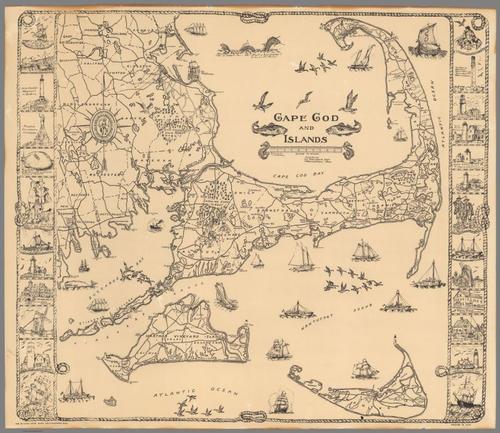
E316 - Cape and Islands - C.W. Holliday - 1934 (Toby Foehl)
- Question
- What are the notable landmarks of the Cape/Islands area?
- Originally published by Ye Ole Town Crier in Provincetown, MA
- Contains Cape Cod, Martha's Vineyard, Nantucket
- Includes roads, cities, coastal towns, forests, Native American settlements
- Illustrations of ships, birds, sea monsters
- Decorative compass in the top left
Source: https://www.davidrumsey.com/
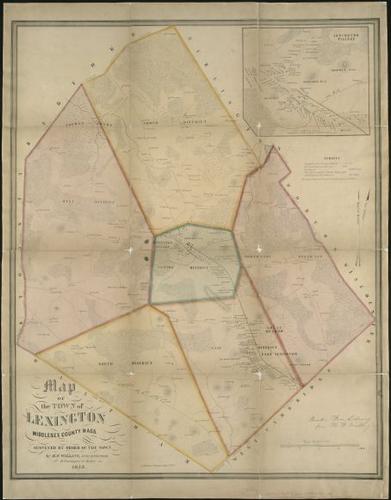
E316 - A map of the town of Lexington Middlesex County, Mass : surveyed by order of the town - Henry Francis Walling - 1853 (Cam Maguire)
Question - Where do people live in the town?
Logic - A survey of the town with every resident who owns land listed and where they live within the town.
System - No compass, there is a scale in the bottom right. Primary use was not for exploration/travel but rather government use so a compass was unnecessary.
Estimation - Land is very detailed, (supposedly) every land owner within the town is listed,
Design - Unused area covered by scale, title, and blown up view of the center of town. Lots of attention to detail as many hills and woodland area are listed on the map, layout is very similar to modern Lexington.
Iteration - One and done, some copies could be made. Main purpose was for the town so they wouldn't have needed too many copies produced.
Link - https://www.digitalcommonwealth.org/search/commonwealth:x059c898m
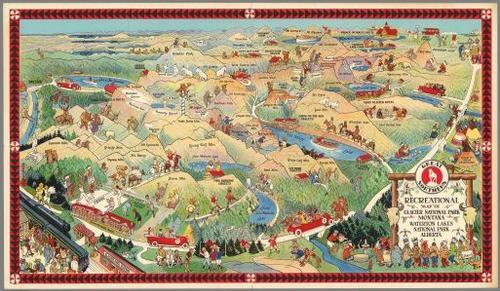
E316 - Great Northern Recreational Map - Joe Scheuerle - 1925 (John Skavlem)
Why you chose the map- Family trip to glacier national park, I saw many similar historical maps displayed that went into the planning of the park. Still, I thought it was really cool to see how this one showed the finished product and everything it has to offer.
Q- What recreational possibilities does our nation afford in its expanding national park system?
- Map created shortly after Woodrow Wilson founded the National Park Service in 1916, which first attractions were taken from federally owned land in the western United States
- The government/parks wanted to showcase newly acquired and repurposed land, and these sorts of promotional works did so, aiding in the early growth of the National Park Service.
L- Aligned like a cartoon version of a pictorial map to capture the artistry rather than the technicalities. Many people and animals showed using the park to its fullest extent to drive home the fact that it is a recreational map.
S- Likely repeated observation of the area allowed the artist to ensure the map is at least somewhat accurate. Still, any sort of system used was likely pushed to the wayside to allow for the artistry to shine through because we do not see any evidence of scale.
E- Large amounts of estimation are surely employed. All notable landmarks on the map look similar to their physical counterparts, but estimations are displayed in a more exaggerated manner. Glaciers are pictured very large and labeled to ensure the park lives up to its name. The glaciers pictured on the map are massive compared to their current size; when I went to the park, most glaciers were almost gone due to climate change.
D- Hand-drawn-vibrant colors and cartoons with non-uniform pictorial layout and scale to point out attractions and accessibility before the American consumer. Attractions like golf links and the Many Glacier Hotel are clearly labeled in bold. Both the legend and the train station are used to fill in areas outside the park borders.
I- Certainly many similar copies, but likely one and done.
Source:
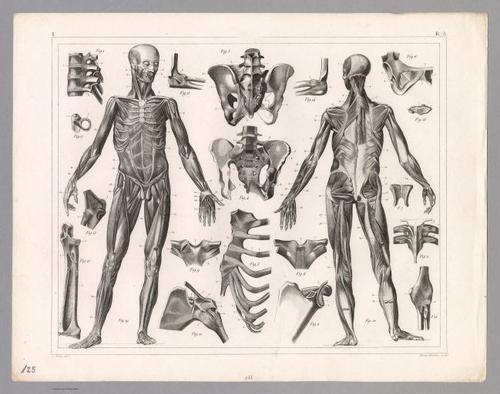
E316 - View: Plate 125. Anatomy including Ligaments and Muscles. - Johann Georg Heck - 1850 (Nicolas Figueroa)
Q - What ligaments and muscles are found in the human body, and where are they located in relation to one another?
L - The body is oriented so that the ligaments and muscles are easily observable from the anterior and posterior sides of the body.
S - Opening and probing human cadavers.
E - The length of ligaments, muscles, and bones is estimated in the drawings.
D - Hand drawn, engraved, and reprinted in “Bilder-Atlas zum Conversations-Lexicon”.
I - Multiple iterations; some iterations placed the bodies in different poses and focused on different muscles.
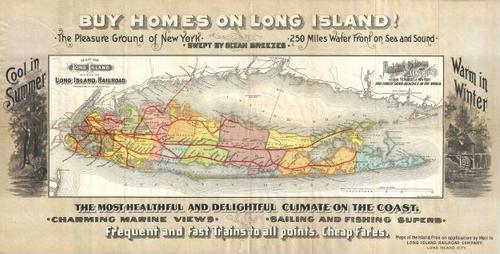
E316 - Long Island Railroad Real Estate Map of Long Island - LIRR - 1891 (David Cooper-Boyce)
Where are the major transport routes of Long Island? For whom and why was this map made? The map is angled in order to show the island as more horizontal, and this was like done in order to further highlight the island's significance. The map was based on an older map of the island made by J.H. Colton and fitted with the LIRR lines, not unlike other maps previously discussed. While copied en masse for its purpose as essentially advertisement for the railway, the original copy is clearly very highly detailed, with more artwork on the borders of the map to further entice viewers.
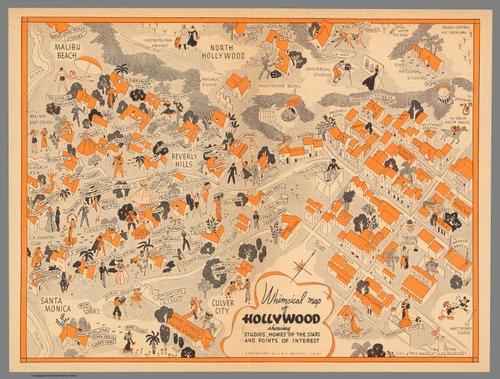
E316 - “Whimsical map of Hollywood showing Studios, Homes of the Stars and Points of Interest” - Allied Artists - 1937 (Luke Zanuck)
The question that the map is answering - What are the logistics of Hollywood? Where are the studios, actors, etc?
The logic employed in making the map - Pictorial birds eye view of Hollywood in 1937
The system of collecting the data for the map - Most likely field investigation.
The way that estimation was used - Heavy liberty was taken for the distances between POI’s. I’m also going to assume that every building did not have the same color scheme.
The design - Orange and black ink was used. Little blank space. Functions as a guide to generally point you in the right direction if you wanted to visit an actor’s house. Does well to segregate the living area of Hollywood (Beverly Hills) from the business part.
The iteration - First edition; was published in a magazine.
Image link
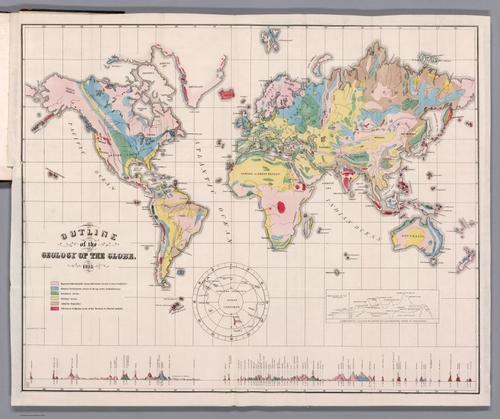
E316 - Outline of the Geology of the Globe - Edward Hitchcock - 1853 (Luci Ludwig)
- Question: What is the geology of the globe? Focuses on strata (layers of rock), volcanic activity, predominant mountain ranges, lakes, drainage and deserts.
- Logic: Depicts the Earth’s geology pictorially. Includes latitudinal and longitudinal lines, as well as a legend.
- System: Exploration (collection of soil samples and observation) and conjecture (Supposed Antarctic Continent)
- Estimation: Regions are general, Supposed Antarctic Continent
- Design: Pictorial, hand-colored, lithographed.
- Iteration: Published as a part of a series, so most likely the only one produced at this time.
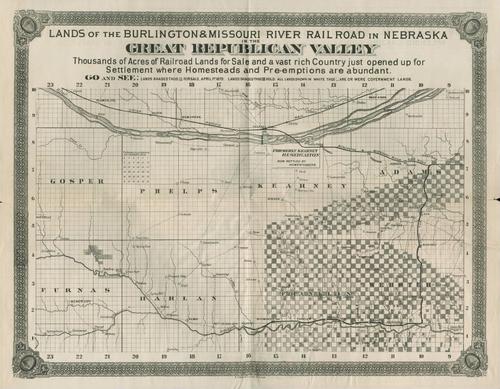
E316 - Map of the “Great Republican Valley” - Chicago, Burlington and Quincy Railroad - 1879 (Ella Marx)
Q - This map answers individuals’ questions: What is out there for me in the North American West?
L - Overview of available land with lots of sign-posting (recognizable names, railroad stops, “this used to be a Kearney reservation, but it's been settled by homesteaders…” etc).
S - Obviously, checkerboarded. Alt. federal/priv.-held lands for 10mi on either side of the railroad; each box represents 1sqmi.
E - Likely lots of estimation used to create this map — it's probably difficult to impose tight, rigid, geometric borders all over a large section of land instead of following the natural contours of the land (like hills, rivers, etc)
D - Map is in black-and-white, w/ printed letters; possbily cheap, printed and reprinted, used as an advertisement
I - Perhaps many of these were made, by different firms
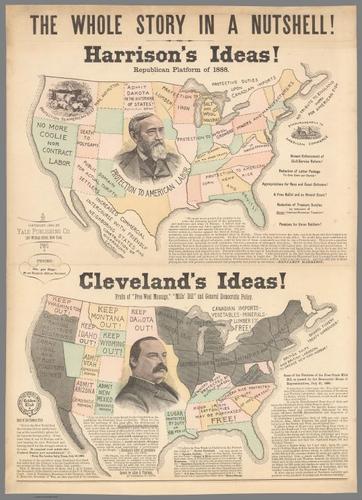
E316 - The Whole Story in a Nutshell! - Yale Publishing Co. - 1888 (Aidan O'Brien-Olwell)
Q: What are the core political differences between Benjamin Harrison and Grover Cleveland?
L: Two contrasting maps of the United States with various regions labeled according to candidate's perceived thoughts about them.
S: Ideas taken from party platforms, speeches, legislative records, purportedly associated groups.
E: The map itself isn't drawn with full accuracy, candidate positions are inferred from mostly indirect evidence.
D: "Broadside" or temporary poster designed for public display, colorful maps with blank space filled by text, portraits in the middle.
I: Produced en masse
Source: David Rumsey Map Collection
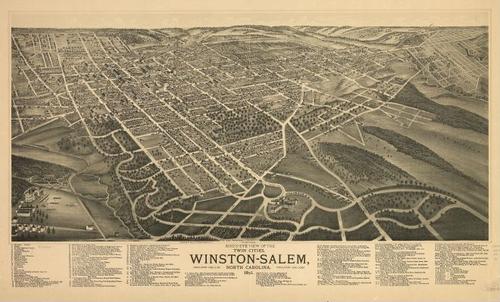
E316 - Ruger & Stoner 1891 (Phillip Clifton)
Q: What is the layout of Winston-Salem?
-Perspective map not drawn to scale
-1 of about 50 of these maps done by Ruger and Stoner
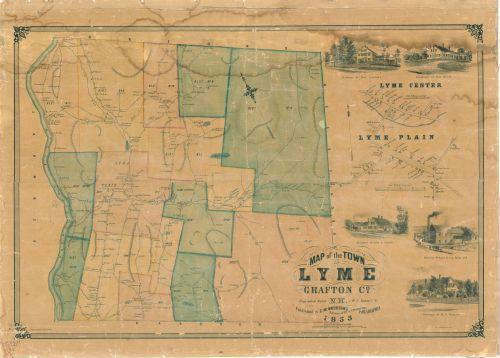
E316 - Map of the town of Lyme, Grafton Co., N.H.- W.C. Eaton - 1855 (Kennedy Lange)
Q: How was Lyme divided into school districts in 1855?
L: Oriented to best fit rectangular paper. North is facing towards the upper left corner of the map.
S: Town Survey by cartographer from Philadelphia. Artistic elements too.
E: Probably the exact distances of roads and between houses are estimated
D: Appears mostly hand-drawn, though names for houses may have been printed.
I: Likely one and done. Appears more artistic than for navigational use, especially given the colors.
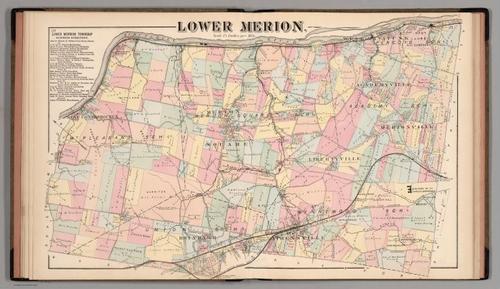
E316 - Lower Merion - G.M. Hopkins - 1871 (Elias Lindgren)
Map of the township from an atlas of Montgomery County as well as Pennsylvania as a whole. Includes names of property owners and business directory.
(regarding Rumsey Map Collection Map Compare tool:)
Question: What's changed in Lower Merion since 1871?
Logic: tool allows you to view present & past maps side-by-side, move the boundary between present & past
System: Archival old map; new, continuously updated basemap; georeferencing and other ~digital technologies~
Estimation: Georeferencing inaccuracies, mainly. 1871 map is very accurate & thorough
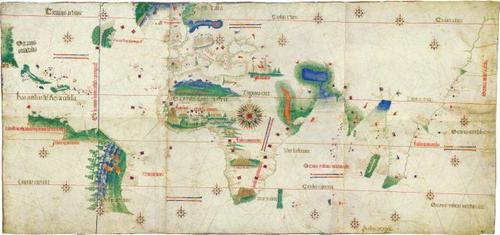
E316-Cantino Planisphere-Unknown Maker-1502 (Tommy Goodwin)
Q: What information do the Portuguese know about the world
L: Mapped using lines of latitude and longitude, meridians using rhumb lines (line that crosses meridians of longitude at the same angle)
S: sightings, compasses, information from previous exploration missions such as Colombus, Cabral, and de Gama
E: Europe and known world more accurate than newly mapped areas such as Far East Asia, Caribbean, and Brazil,
D: Hand drawn using ink, pigments on vellum (animal skin) Beautifully drawn images of trade centers like Venice and important religious cities like Jerusalem. Areas that are more detailed elsewhere represent where Portugal has explored
I: one and done. Original copy housed at Biblioteca Estense in Modena, Italy.
Link:
https://en.wikipedia.org/wiki/Cantino_planisphere
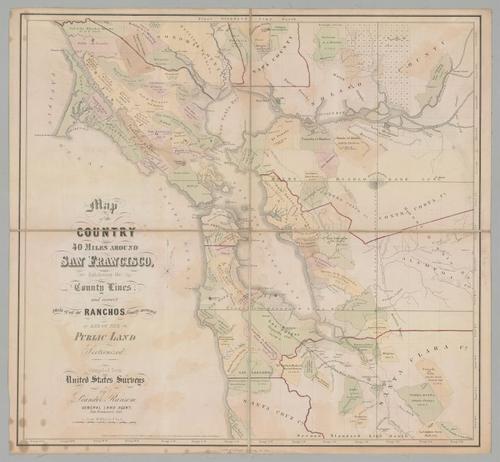
E316 - Map of SF Bay Area, Showing Land Grants and Counties - Leander Ransom - 1860 (Leo Marburg)
Q: Where are ranchos located within the Bay Area?
L: Show Bay Area from north to south, use a different color for each unit of property, and use thick red lines to denote county markings
S: Analyzed data from the United States Survey
E: More limited information on physical geography, unclear boundaries on ranchos
D: colored lithograph, hand colored
I: A few other copies were made, with some minor changes, such as coloring
From Stanford Libraries Warren Heckrotte Map Collection, https://exhibits.stanford.edu/heckrotte/catalog/ks063fz4690.
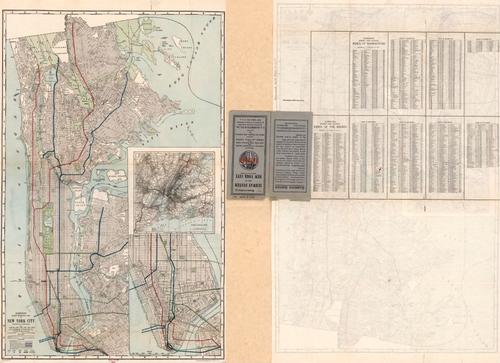
E316 - Hammond's subway system map of New York City - C.S. Hammond & Co. - 1921 (estimated) (Sam Wexler)
Link: https://www.loc.gov/resource/g3804n.ct008314/?r=0.04,0.343,0.123,0.062,0
Q - where are subway stations located in relation to the streets of New York and the subway lines themselves?
L - Bird’s eye view from straight above the city, oriented so NY is perfectly North-South
S - “Based on the Official Map of the City of New York by the Board of Estimate and Apportionment” - all I found were official style guidelines that matched this map, so may be based off a pre-existing map. Otherwise, presumably sighting and compass.
E - Likely estimated distances and specifics of subway lines.
D - overall minimalist feel (few buildings or decoration, mainly streets/labels and ports) with the subway lines in accented, bright colors and circles for each subway stop. Positioned as a subway/elevated lines map that also contains street indices.
I - likely distributed as a guide to the city.
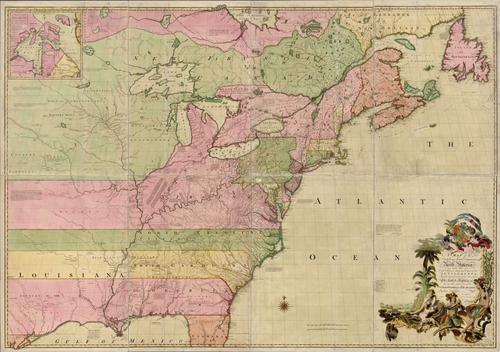
E316 - Map of 13 Colonies (Vaughn Sanders)
Q: Where the “correct” borders of each of the 13 colonies are according to the British.
L: The map very clearly extends the borders of southern states westward in order for the British to appear as if they control more territory than the French.
S. Created by John Mitchell using information from British governors of the colonies.
E. Estimation was very blatantly used in the extension of states like South Carolina past the Mississippi river.
D. This map is not overly decorative and feels pragmatic, so it would seem that this map could be used for anything business or government related.
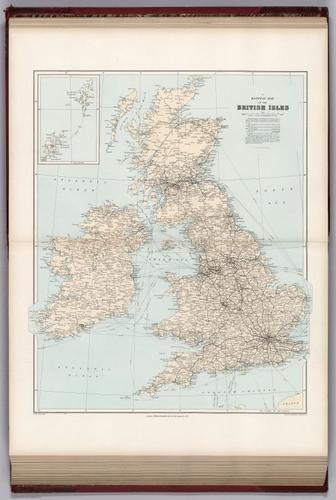
E316 - Railway map, British Isles - Edward Stanford - 1904 (Myer Liebman)
Q - Where are railway lines located in Britain, which towns have stations, and how frequent trains are on each line
L - Shows railway lines and stations on a map of Britain
S - Railway routes and stations, railway timetables
E - Only shows coastline and train routes, doesn't show any roads, canals or towns without railway stations
D - Printed in color in an atlas
I - Third issue of Stanford's atlas
From David Rumsey
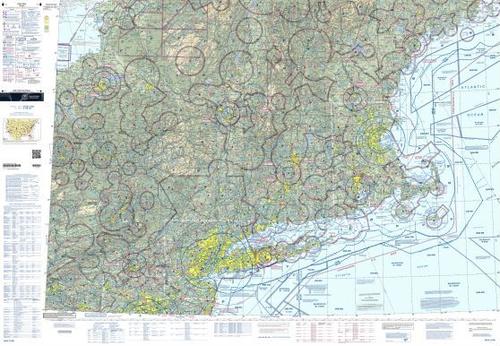
E316 - New York Sectional - FAA - 2022 (Jacob Cohen)
Q: What type of airspace is at any spot? What visual references to the ground are there? Where are airports?
L: the US is divided up into different regions for easily manageable paper sectionals. All oriented with true north at the top.
S: FAA surveys and user reports.
E: Ideally none though some boundaries and terrain elevation figures are rounded.
D: Printed on paper in color in sections or available online as one larger map.
I: Began in 1930 and now updated every 56 days.
Other sectionals: https://www.faa.gov/air_traffic/flight_info/aeronav/digital_products/vfr/
Online version of all sections combined: https://skyvector.com
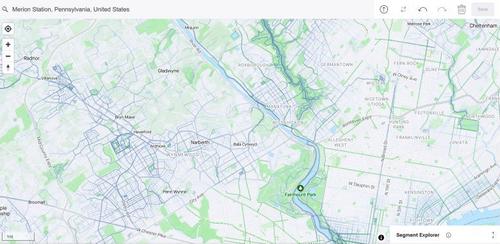
E316 - Strava Heatmap of Philadelphia Suburbs - Strava - 2023 (Elias Lindgren)
Question - Where have people been running (where might you want to run?)
Logic - Overlays aggregated GPS data from user activities onto a basemap
System - Big Data. .gpx files (w/ timestamps and gps locations) from users all baked together into one object
Estimation - Only has data from Strava users of course, so not a complete map of where people are running, might be subject to some biases on that account.
Design - Heatmap: darker, thicker blue = more running there
Iteration - Continually updated as more user data comes in
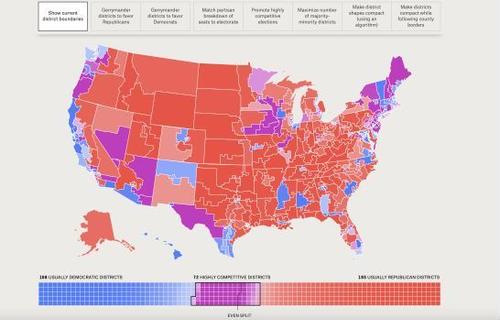
- E316 -The Atlas of Redistricting (Josh Rubel)
| Question | How can the different gerrymandered district boundaries affect the outcomes of elections? |
| Logic | Using the district map of the US and a developer's redistricting tool, they created 2,568 different congressional district maps. |
| System | US congressional districts |
| Estimation | Rough estimation of borders and coastlines |
| Design | Available digitally |
| Iteration | Only on fivethirtyeight, updated after states change their district borders. |
E316-Map of the Internet Information Architects (Simon Kent)
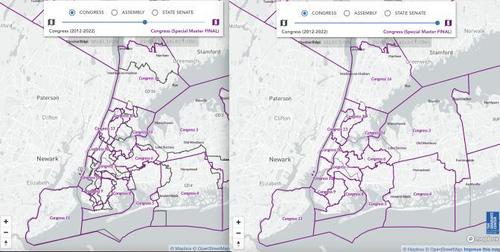
E316 - NY Redistricting & You (Audrey Liu)
Q - What do new NY Congressional, State Senate, and State Assembly districts look like? How do they compare to previous ones? How do different drafts of the same map compare?
L - On top, the user selects whether they're looking for Congressional, State Senate, or Assembly district maps. To the right (not pictured), a dropdown box allows the user to select the specific map proposal (examples include the version passed by the assembly, later declared unconstitutional, and the version supplied by the opposition). The slider on top allows the user to overlay that draft with the current district lines as they stand.
S - The map uses several sources, including: map data from Open Street Maps, current district lines from the census bureau, and proposed district lines from the NYS Redistricting Commission.
E - Very little is estimated. While the line thickness prevents pinpoint accuracy, the user can zoom in to the see the exact city blocks the line divides.
D - The data is overlaid onto Mapbox.
I - The slider function along the top and the dropdown menu to the side allow the user to view several iterations. The website is periodically updated as new proposed maps are released.
NYS Redistricting & You is a project of the CUNY Mapping Service at the CUNY Graduate Center.
https://newyork.redistrictingandyou.org/
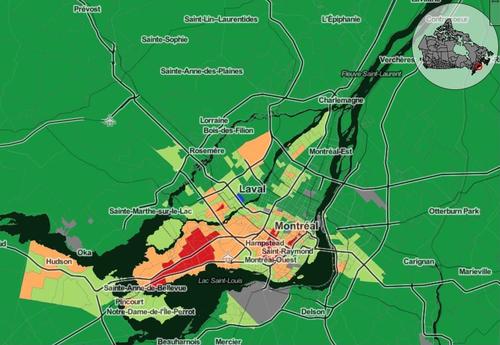
E316 - Linguistic Map of Montreal - censusmapper.ca/Patrick Murphy - 2016 (Ella Marx)
This map represents the proportions of citizens with French — as opposed to English — as their first language throughout different areas of Montreal. However, this map doesn't consider other languages (Spanish, Arabic, etc) that may constitute some Montrealers' first languages.
Link to the interactive map: https://censusmapper.ca/maps/2348#10/45.5924/-73.7217
Link to CBC article with other interesting/recent maps of language in Montreal: https://www.cbc.ca/news/canada/montreal/multimedia/maps-tell-story-of-montreal-s-changing-linguistic-landscape-1.4244255
Question - Who in Montreal speaks French as their primary language?
Logic - Gradient color scale representing different densities of those with French as their first language (not necessarily native French speakers); shows historical remnants of English/Protestant and French/Catholic power in the city
System - Organized into small tracts, each composed of several city blocks in area
Estimation - Probably as accurate as possible, since it's based on census data from 2016
Design - Computer-generated
Iteration - Several cool Canadian maps on this site generated by recent census data
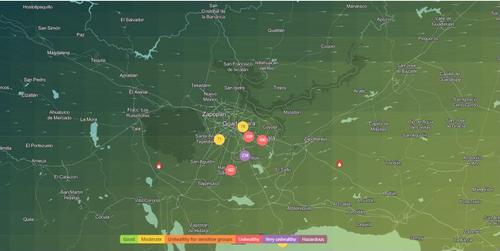
E316 - Guadalajara air quality map: Live air pollution map of Guadalajara (Nicolas Figueroa)
Q - What is the air quality in various suburbs of Guadalajara, Jalisco?
L - No extra elements exist on the map except for roads, which are not named. If you zoom in further, you can see some smaller roads. Clutter is avoided.
S - There are multiple stations that are collecting air quality reports through Guadalajara.
E - There are few stations, so there are no accurate reports for every city section.
D - Digital; mostly blank map except for outlines of roads; colored dots signify air quality stations and severity of air quality.
I - Multiple iterations; the map is updated every few hours.
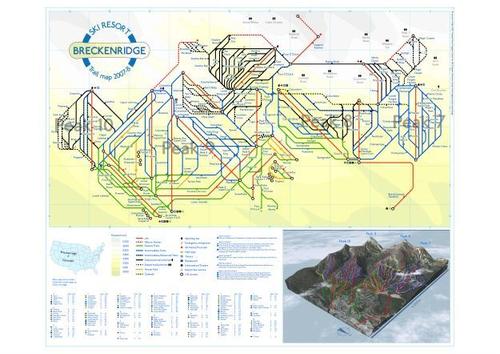
E316 - Breckenridge represented tube-style - Kenneth Field - 2007 (Annie Gustafson)
Q - Is a schematic diagram a sufficient guide when navigating a ski resort? (Define sufficient: what are a map user’s goals when reading a ski map? To get from place to place, or to properly anticipate the terrain/journey ahead?)
L - Schematic diagram that shows not the geographic locations but the relative positions, difficulty ratings, and connection points of different trails and lifts.
S - Organized under a schematic framework.
E - This map forces linearity onto the map, taking a radical leap away from precision.
D - Design–an attempt to solve a problem–is where this map falls short. Schematic maps strive to omit all details that are not relevant to the key information. Kenneth Field assumed that the key information on a ski map is similar to the key information on London’s tube map – to find the most efficient route from one place to another. This is rarely a ski map user’s goal. A skier values the quality of their journey–length, terrain, orientation to the sun or wind, aesthetic surroundings, etc. Field’s map diverges from a traditional, panoramic ski map by omitting steepness, the orientation of slopes, and visual reference of trees, rocks, and undulation of the slope along the run. Relevant information regarding the journey itself is important for the ski map user experience, and it’s sorely missing from this schematic map.
I - One and done. This map never really caught on in a ski resort context.
A more typical map of the same area: https://skimap.org/data/510/150/1665455999.pdf
Field’s tube-style Breckenridge map: https://skimap.org/data/510/1/1288021972jpg_render.jpg
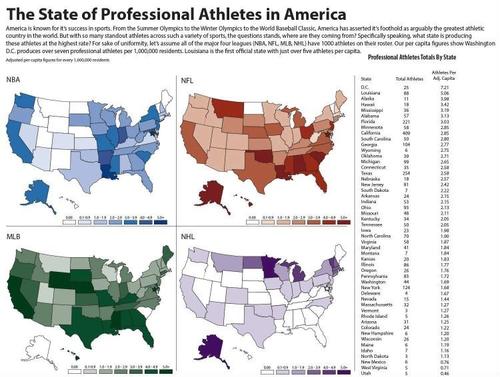
E316 - The State of Professional Athletes in America - Jacob Rude - 2014 (Donnie Morton)
- Which states do professional athletes tend to come from depending on the sport?
- Color codes states based on how many pro athletes in the respective sport were born there
- color-coding
- Not really any estimation
- Digitally created map
- Digital file (jpg)
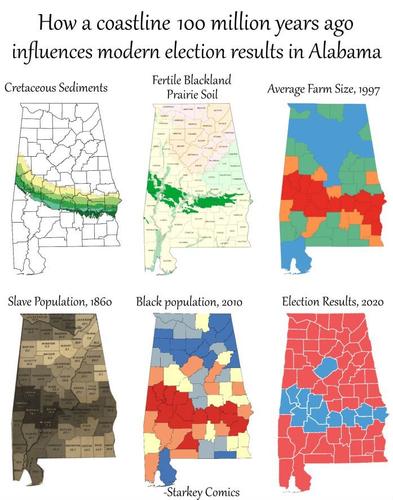
E316 - How a coastline 100 million years ago influences modern election results in Alabama (Ryan Guo)
Q - Why is there a horizontal strip of counties that voted Democrat in Alabama?
L - Six maps of Alabama are displayed together.
S - Slave populations and modern black populations were gathered from censuses. Election results were gathered from the Electoral College.
E - Coastlines are reasonably drawn.
D - Counties and sediments are color coded.
I - Appears in a blog by a comic artist. Circulated online.
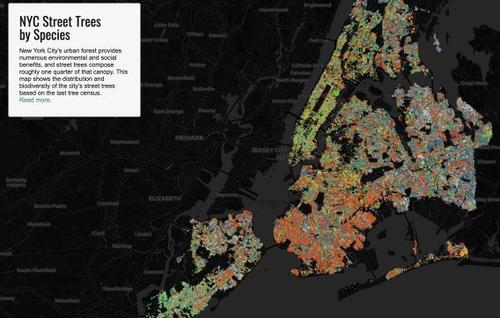
E316 - New York City Street Trees by Species - Jill Hubley - 2015 (Chiaka Duruaku)
http://jillhubley.com/project/nyctrees/
- Q: “What are the types of trees in NYC, and where are they dispersed?”
- The logic: New York City's urban forest provides numerous environmental and social benefits, and street trees compose roughly 25% of that canopy. However, it also reveals many invasive types of trees.
- The system of collecting the data: Jill Hubley writes, “The map represents trees surveyed during the last tree census, in 2005. The next tree census is happening this year. I'll update the map when the new data is released. Additionally, in January 2015, I filed a FOIL request for the 1995-1996 tree census data, though have yet to receive it. ”
- The way that estimation was used: As Hubley writes, “The data for the map comes from NYC's open data portal, where it can be downloaded by borough. I opened the CSV files in QGIS, reprojected them to web mercator, added geometry columns to the attribute tables, then exported each table to CSV. I built the map using cartodb.js and leaflet.js. Part of the reason for the split was that no one table could exceed 500,000 rows (there are roughly 600,000 trees on the map.) There is also a separate table with the common name of each tree and its corresponding tree code.”
- The design: A classic road map, where interstate highways are shown connecting land masses. The backdrop is navy with gray outlines. Boroughs are labeled. The outside NYC and just inside the tristate area. Someone can view the map by using the tooltips and zoom function to identify particular trees, or by using the filter option to see distribution.
- The iteration: A necessary map, but I haven't seen it anywhere.
- Why I like this map: It fulfills these criteria- “A map is an abstraction that helps us understand (and navigate) physical reality. A piece of art is an abstraction that helps us understand and experience the artist’s point of view. A work of history is an abstraction that helps us understand the reality of what has happened.” It's also cool to see which trees live where I am living.
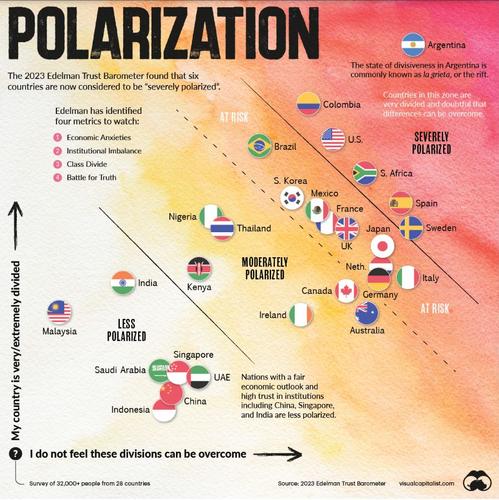
E316 - Which Countries Are Most Polarized? - Edelman & Visual Capitalist - 2023 (Tom Paper)
Q: which countries are politically polarized?
L: surveying about 1,000 people / country in 28 countries…I wonder how they objectively found 1,000 people in each country…I wonder why they only did 28 countries and how they picked those countries.
S: i'm guessing they had some way to survey respondents, by phone or email…curious how they did that…
E: estimation is inherent their choice of about 1,000 people / country…32,000 total
D: i think the design was made by Visual Capitalist, but the survey was completed by Edelman Trust, which is an offshoot of the Edelman public relations company…Design uses circles with flag colors…reddish more to upper right…but not perfectly red to upper right…
I: the survey has been done for at least three years…don't know about the map…
https://www.visualcapitalist.com/polarization-across-28-countries/
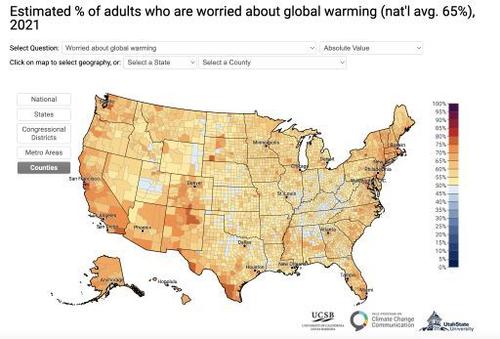
E316 - Yale Climate Opinions Map 2021 (Kennedy Lange)
Question: What percentage of adults are worried about the chosen issue ( for example “global warming”)
Logic: The US can be broken down into different size partitions, f.e.x counties, states, and national percentages. Each partition is color coded based on a scale of 0-100% of people who believe in a specific issue.
System: Consensus data and surveying by the Yale Climate Group inform the percentages per each partition.
Estimation: Presumably these percentages are not entirely precise, though they are the best estimates we can make about the overall feelings of people in each partition.
Design: Computer generated
Iteration: One, but widely available on the internet.
Link:
https://climatecommunication.yale.edu/visualizations-data/ycom-us/
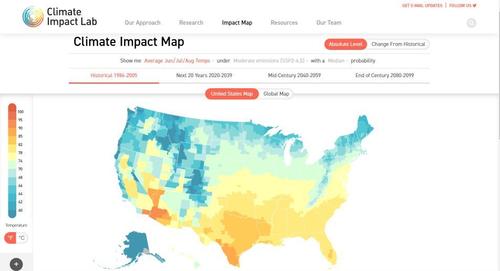
E316 - Climate Impact Map (Luci Ludwig)
Note: Screenshot only shows map of the U.S, but a global map is available on the website.
Question: How has the climate in the U.S. (and the world) changed over time?
Logic: U.S. and global maps divided into regions with similar climate patterns and practices. A gradient scale is used to show the differences between these regions, states, and countries.
System: Climate projections based on historical socioeconomic and climate data. Study known as the World Climate Research Programme’s Sixth Coupled Model Intercomparison Project (CMIP6).
Estimation: Based on a 2016 study, so relatively recent data. The predictions for the mid century and end of century periods could change.
Design: Digitally generated
Iteration: Most likely updated as frequently as possible with new data.
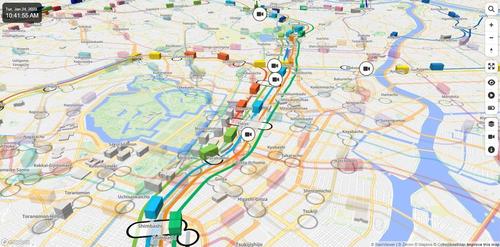
E316 - Mini Tokyo 3D - Akihiko Kusanagi - 2019 (Spencer Huang)
Q - What does the real time map of Tokyo transit look like?
L- Aligned northwards, but you are able to change the orientation
S - Various data sources
E - Data is abstracted at various levels (ie buildings only show up when zoomed in)
D - obtained from data compiled from various open sources, such as OpenStreetMap
I - Always updated with the most recent information
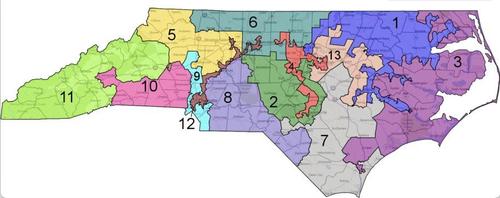
E316 - North Carolina Gerrymandering Map (Phil Clifton)
-Districts shown are from 2014 elections
-1 and 12 were deemed to be racially gerrymandered and, therefore, unconstitutional
-1 and 12 were drawn by state Republicans following the 2010 census in an attempt to increase their majority in congress
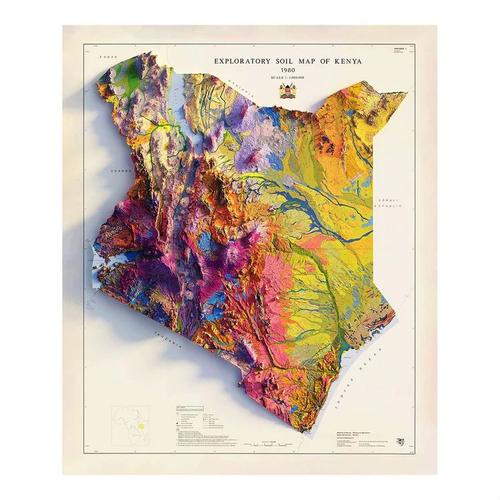
E316 - Kenya 1980 Shaded Relief Map - Sean Conway - 2021 (Luke Zanuck)
This map is a part of a series of enhanced vintage maps by Sean Conway, an expert in GIS. The point of his project is to enhance old maps to accurately portray elevation data. However, they come off more as pieces of art with their stunning colors and ostensible 3D-ness.
Conway makes the maps by marrying a publicly available vintage map with current-day elevation data. First, he georeferences the vintage maps so the data lines up properly. Then, he uses ArcGIS Pro to impose the elevation data on the map. Finally, he uses Blender to make the map look 3D, and the geographic features of the world hyperrealistic.
Link to all maps
Sean Conway twitter
Higher res image
Question: What are the geographic features of Kenya? How does the elevation change? How does this align with the different soil of Kenya?
Logic: Conway's enhancement stays true to the original map.
System: Original data from surveys, elevation data from scientific databases.
Estimation: In cases were the vintage maps are inaccurate, he alters the elevation data relatively in order to maintain the OG map's form.
Design: 3D-ness, colors, are very visually striking.
Iteration: You can buy prints online.
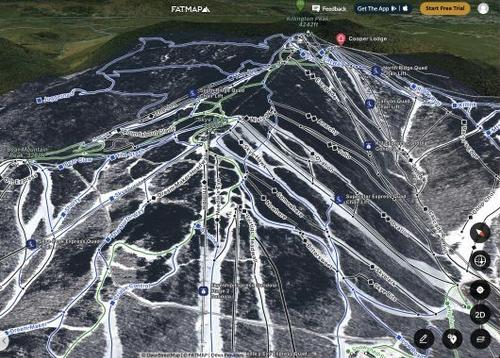
E316 - FATMAP (Sam Wexler)
Link: https://fatmap.com/adventures/@43.6076594,-72.8002799,2333.7427296,-26.4994275,-130.563515,1105.9417052,satellite,winter (It will ask you to make an account, but it is very quick)
Q - How can I navigate and interact with natural terrain, primarily mountains?
L - A digital, 3 dimensional map of the Earth that captures the topography as closely as possible.
S - Uses open source mapping data from a variety of sources and satellite imagery. Also receives qualitative data from users on trail difficulty, characteristics, etc.
E - Trail-specific data is likely estimated using data from the map. Other estimations possibly include the general shape of the mountains and land.
D - The base map corresponds as closely as possible to how the terrain actually looks and displays the trail name in difficulty-accurate color. Essential roads and interest points are included on the map. Different map overlays use colors to visually represent the corresponding theme.
I - The map does not change from what I understand, so it is made/stored once and loaded whenever a user accesses the site. However, every time a user-created Route is added, the map must be modified and in a sense “re-made”.
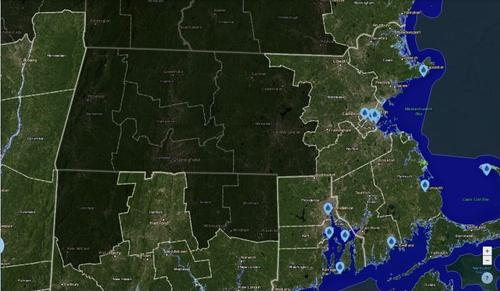
E316-- Massachusetts Sea Level Speculations Map--Stone Murphy
Follow this link to use the interactive map:
Q. This map aims to answer the question of how rising sea levels will impact coastal communities in the coming years. This is a question that more broadly addresses climate change.
L. This map uses data from the National Oceanic and Atmospheric Administration to make projections that overlay a common land map. These projections allow users to easily visualize the impacts of climate change.
S. This map serves six different purposes. The main feature is an estimation of land lost as the sea rises in increments of one foot. The second feature allows the user to click on certain coastal cities and provides a unique estimation of how much the sea will rise on a sliding scale ranging from the ‘intermediate low’ worst-case scenario to the ‘high’ worst-case scenario. The third feature is similar to the first, but highlights areas of lower mapping confidence in orange. My main takeaway from this feature is that some areas may not be flooded thanks to human intervention at first, but past a certain number of feet flooding will ensue regardless. Sea walls will only withstand the pressure of so much water. Some areas will not be flooded, but will still be impacted by marsh migration. Marsh migration will make some areas infertile for farming as well as unsafe for development. The fourth feature allows users to view the development of marshlands in accordance with rising seas in increments of half a foot. The fifth feature is a vulnerability projection. It uses a heat map to indicate regions that are most to least vulnerable. The final feature is not a projection, but a graphic of areas impacted by high-tide flooding. A bar graph can be viewed for certain cities that have reliable data on days of high-tide flooding each year dating back to 1920.
E. This map estimates changes in sea levels and the land that will be flooded, the severity of different case-scenarios, and the encroachment of marshlands. The estimations are highly speculative, as indicated by the mapping confidence feature.
D. This is a satellite map of the United States, similar to Google Earth (possibly even powered by Google Earth). Some features offer a change in design. The rising sea level feature has a blue overlay on land that is projected to be flooded. The marshlands feature highlights marshlands in blue. As sea levels rise, current marshlands often disappear in some places and emerge in new, more inland ones.
I. This is the third iteration of this map. Since it is a live service provided by the US government, updates are made to each individual iteration of this map, similar to IOS updates. (i.e. version 1.2.0, 2.1.1, 3.0.0)
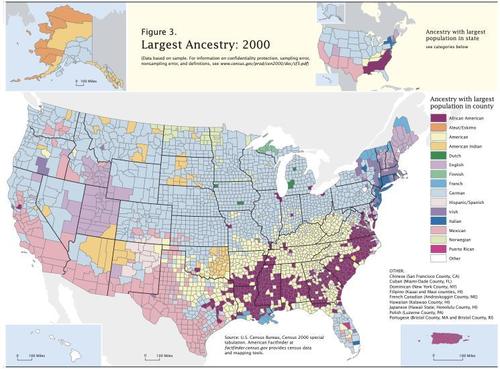
E316 - Map of U.S Ancestry - U.S Census Bureau - 2000 (Vaughn Sanders)
Q: What ancestry of people has the largest population in each county of the U.S
L: Uses county data and a range of colors with a key to define which ancestry is the most popular in each county.
S. Using data procured from the 2000 Census of the U.S
E. Although the vast majority of people respond to the census, there's not really a way to ensure people respond truthfully. As a result, the data in this map suffers from response bias and might not be entirely accurate.
D. The design is practical, logical and pragmatic. It is colorful only out of necessity (to describe the different ancestries most clearly) and no other artful design elements
I. First iteration
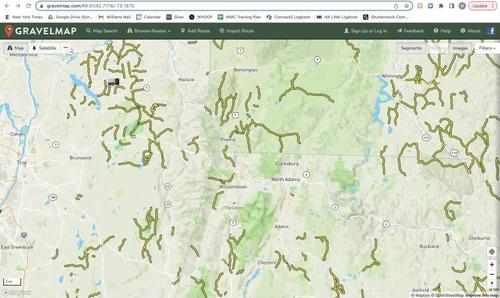
E316 - GravelMap - Whitewater - 2023 (Myer Liebman)
Q - Which roads are gravel or dirt roads
L - Highlights roads that are gravel or dirt
S - Relies on user input to figure out which roads are gravel or dirt
E - Not all gravel or dirt roads are on the map, and some former gravel or dirt roads may now be paved
D - Highlights gravel or dirt roads overlayed onto a standard OSM map
I - Online map, continuously updated as users add new roads
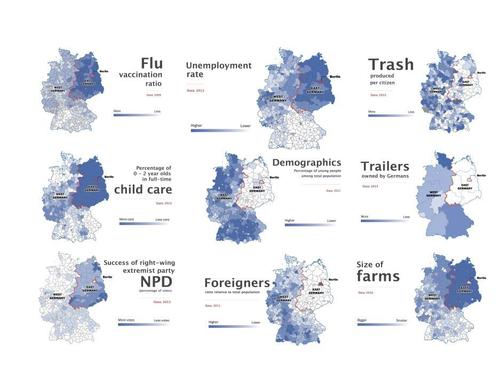
E316 - Maps Detailing the Contemporary Divisions between the Eastern and Western parts of Germany - Rick Noack - 2014, data gathered between 2009 and 2013. (Bradley St. Laurent)
Source/Inspiration: Source: https://www.washingtonpost.com/news/worldviews/wp/2014/10/31/the-berlin-wall-fell-25-years-ago-but-germany-is-still-divided/ Inspiration: https://www.reddit.com/r/MapPorn/comments/kszv2f/germanys_religious_divide/ , https://vividmaps.com/germany-is-still-divided-by-east-and-west/
Question: Decades after reunification, in what ways are the Eastern and Western regions of Germany still divided?
Logic: Each map portrays Germany and its districts, with the red line marking the place of the old border between East and West Germany. The data for each district is represented by its color.
System: For each map, data for each district is collected from surveys/interviews/censuses, and then presented as percentages/ratios/per-capita-statistics, depending on what details the map focuses on
Estimation: Because one cannot just interview every single resident of each district, the data is sourced from sample surveys, and is then extrapolated using statistical tools to represent the district population as a whole.
Design: The colors of each district indicate the intensity or presence of the map’s focus in that specific district, with dark blue being higher/bigger/least, and white being lower/smaller/least. A design flaw could be related to the fact that the minimum and maximum of each scale is not reported, meaning that the disparity between Eastern and Western counties could be exaggerated. For example, if there was only a .5 percent difference between the most and least-vaccinated German counties, but the scale only went from 80% to 81%, the difference would be exaggerated far beyond the true, less intense difference. I also wonder if the addition of the red border line emphasizes differences more than they would be without the border.
Iteration: Each based off a survey, so only one of its exact kind, although other maps surely focus on similar ideas.
E316 - Speculations
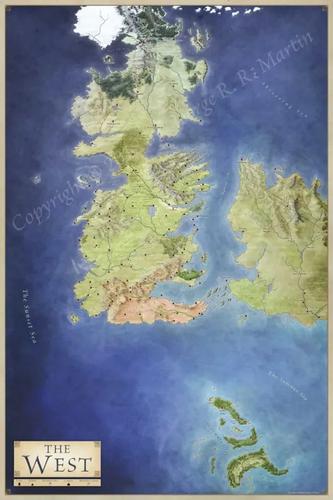
E316 - The West-George RR Martin-2012 (Tommy Goodwin)
Q: where does the Song of Ice and Fire take place? What does Westeros look like? Where do the noble families rule? Where are the story locations?
L: Traditional overhead view on 2D plane with proper direction alignments.
S: map is made up but is inspired by the shapes of the British Isles
https://brilliantmaps.com/westeros/
E: long production time. Made for the atlas of George RR Martin's world: The Lands of Ice and Fire
D: hand drawn and edited with computer, based on real Earth locations (ie. Hadrian's Wall, England, Ireland)
I: this is the official iteration but countless versions of Westeros have been recreated in different styles
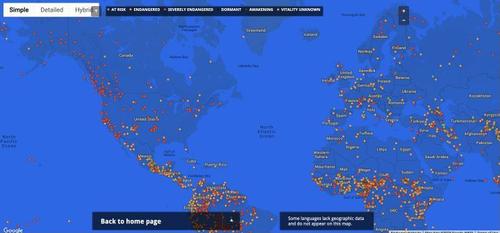
E316 - Endangered Languages Project Map, Screenshot from 1/25/23 (Leo Marburg)
This is a screenshot from the Endangered Languages Project's interactive online map, found at https://www.endangeredlanguages.com/#/8/46.525/10.711/0/100000/0/low/mid/high/unknown. This is a website that helps to promote endangered languages around the world by mapping them, and listing their risk status. The website is sponsored by the University of Hawaii, Eastern Michigan University, the First Peoples Cultural Council, as well as supported by a grant from the National Science Foundation. I thought it was super sad how many endangered languages came from the US, and interesting how there were non-Indigenous languages on this list as well, like Cajun French, and Pennsylvania Dutch.
https://www.nytimes.com/interactive/2024/02/22/magazine/endangered-languages-nyc.html

Leo sent me this link on February 27, 2024. I love it!
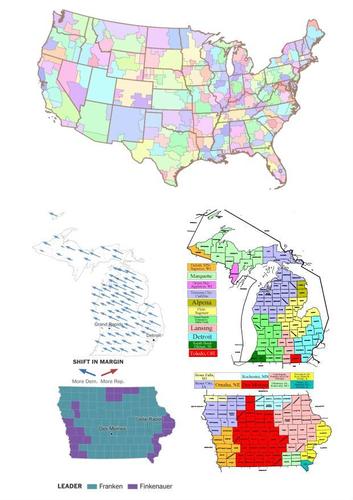
E316 - Media Markets and Voting - Wikipedia, The New York Times, EchoStar Knowledge Base - Data from between 2006 and 2022 (Aidan O'Brien-Olwell)
Q: What patterns involving TV media markets and voting behavior can be observed in Michigan and Iowa?
L: NYT maps indicate swing from 2020 to 2022 or county winner, while EchoStar maps show county borders and color them by market.
S: Information taken from online resources which themselves compiled numbers from relevant government authorities.
E: My conclusion is partially speculative, inferring patterns that can't really verified.
D: Each map uses color to differentiate areas based on their characteristics, placed adjacent to one another for ease of comparison.
I: Each part available online, regularly updated.
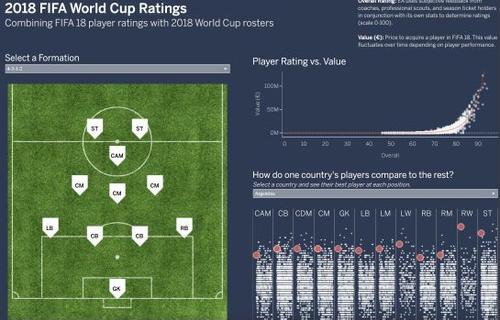
E316 Scott Teal – Fifa World Cup Rankings – 2018 (Toby Foehl)
Q - How do Fifa rankings of individual players compare between all the teams in the 2018 world cup?
L - Players are listed as individual data points in the map on the bottom left. The bar allows to view any of the 32 teams. Positions correspond to the field map on the left.
S - Rankings from FIFA are used to display visually the “value” of the players in the world cup.
E - Data used from FIFA at the time of the 2018 world cup. Does not appear to include every player on every roster in the World Cup
D - Utilizes two ways of mapping players' value. Bottom allows for teams to be viewed together while separating the individual value of each player. The top visual illustrates the correlation between a player's ranking and the price to acquire them in the game.
I - Only iteration
I chose this map because I was interested in the idea behind it. It's a fun way to visualize the quality of each team in terms of fifa rankings. I think it's interesting to view teams that did well in the World Cup but do not necessarily have the highest individually rated players, such as Croatia. There are a lot of things this map does not do, such as allow you to compare multiple teams together at one time. Not to mention the visual on the left is more or less useless for anything besides understanding what a soccer field looks like. Nevertheless, I found it a fun way to visualize all the rankings of the different players and how individual player rankings vary drastically across teams.
^seems like an interesting site with a lot of different data visualization tools
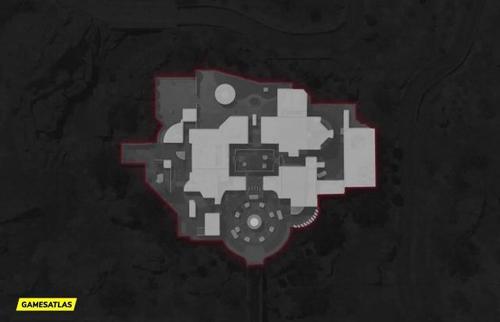
E316 - Raid Map Layout - 2012 (John Skavlem)
Cod Map Raid:
I wanted to think of the ways I use maps in my everyday life, and the world of video games is an interesting field that places lots of value on map design
Quick game overview - Players play the same map many times over so the quality of maps plays a large role in determining the quality of the game itself, many multiplayer games that are remembered fondly today are remembered in this way because of their maps. Players can agree that maps which are considered to be “good” are objectively more fun to play on than ones that aren’t.
Logic: Good maps pay close attention to factors like their lines of sight and how they allow players to move through them. This map above adopts the popular three lane design, which a great model for making an effective map. These components also have an effect on the overall size of the map which directly affects the pace and predictability of the game. Maps can be too small or too big leading to chaotic or dull games based on the map's size or complexity. Some of the worst maps we see in games are maps with too much clutter that offer no consistent lines of sight, allowing for someone to pop up from any angle in front of you.
Design: When it comes to design in a scenic sense, maps are designed based on consumer appeal. New games bring new iterations of maps with certain changes. Changes like the theme of the map's scenery or the setting of the map are often switched up when they are re-released in order to better appeal to the target audience. A design element like a strong theme can help make a map much more memorable to the player base. Because at the end of the day the point of releasing a video game is to sell copies.
Iteration: Some maps have multiple versions across multiple games as game developers bring back popular ones based on fan feedback.
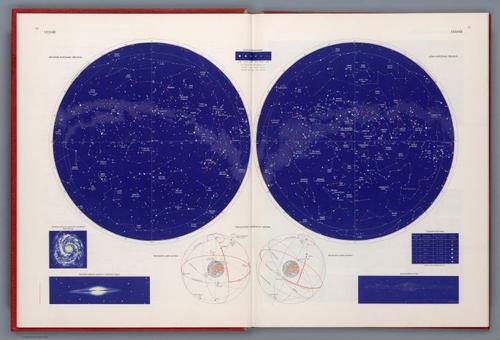
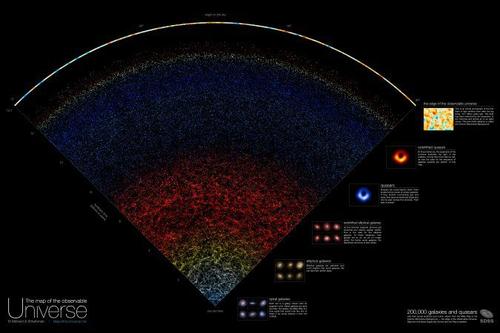
E316 - Map of the Universe - (Cam Maguire)
Question - Where are galaxies located in the universe in relation to the milky way? Are these galaxies red-shifted or blue-shifted?
Logic - With the Milky Way galaxy at the bottom, the map expands out into a cone shape with over 200,000 other known galaxies displayed. The map is color coded as blue galaxies are closer to us and red are farther away.
System - Digital mapping using 15 years of data collected every night from New Mexico.
Estimation - None of this has been seen by human eyes so all of the locations are done using calculations so there could be some error but for the most part the positioning is very accurate.
Design - Very precise, lots going on. Over 200,000 galaxies mapped. Some descriptions for some of the galaxies and quasars are listed.
Iteration - Published online - anyone can access.
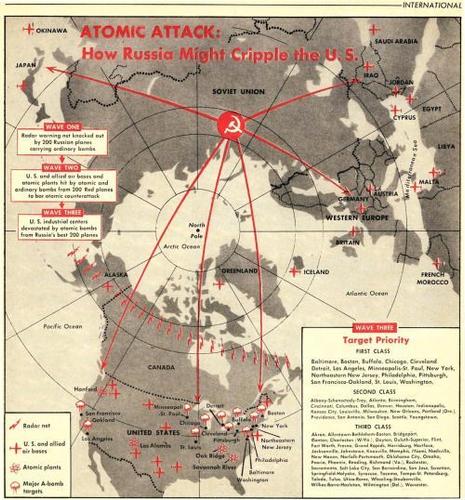
E316 Atomic Attack: How Russia Might Cripple the U.S. (David Cooper-Boyce)
Q: Which US cities are the most likely targets for a nuclear attack?
L: Cities were likely either chosen for their population or size alone.
S: The map is a top down view of the northern hemisphere, which is an excellent way of showing potential threats from the Soviet Union by way of air while also showing Europe, parts of Asia, and North Africa, all of which would likely be affected parties.
E: This entire map essentially is based on estimation and speculation. While most if not all of the cities listed here would likely have been hit had war broken out, the creators did not know what the actual outcome would be.
D: The design, while fairly simple, is appealing to me in its vintageness. As well, the information on the sides that explains the target priority is interesting.
I: While I couldn’t find much information about who this would have been shown to and how many copies were made, it seems like something more simple in nature than an official military map. This leads me to believe it was printed en masse to civilians to inform them about their safety in the event of nuclear war.
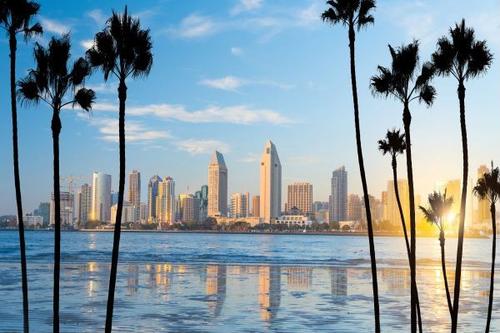
E316 - Google MyMaps - Key Locations in Sunny San Diego (Joseph Grillo)
Place a DOT on the image


Normally, the Mayflower’s cargo was wine and dry goods, but on this trip the ship carried passengers: 102 of them, all hoping to start a new life on the other side of the Atlantic. Nearly 40 of these passengers were Protestant Separatists—they called themselves “Saints”—who hoped to establish a new church in the so-called New World. Today, we often refer to the colonists who crossed the Atlantic on the Mayflower as “Pilgrims.”